The best roof bike racks allow bikes to be transported safely and securely up and out of the way of your vehicle’s trunk or rear hatch. While the rooftop-style bike rack may not be as popular as it once was, the available options are better than ever.
If you don’t want to install a tow hitch on your vehicle, roof racks are a great alternative to hitch racks. They work well on their own or can be an easy way to add carrying capacity to your vehicle’s hitch rack setup. Additionally, the crossbars that support your bike roof rack can accommodate racks for other types of outdoor activities, allowing you to customize your adventure rig.
To find the best roof bike racks, we rounded up a selection of nine different models to test and compare. From the top-rated Yakima HighRoad to the high-end Kuat Piston SR, we’ve got recommendations to suit your rooftop bike-carrying needs.
Editor’s Note: This guide was relocated from our sister site, GearJunkie.com, on December 5, 2025, and updated to include the Allen Smart Suction Rack and the SeaSucker Talon MAX.
The Best Roof Bike Racks of 2026
Yakima HighRoad

- MSRP: $349
- Type: Wheel-on
- Weight capacity: 45 lbs. (off-road rated to 27 lbs.)
- Rack weight: 18 lbs.
- Wheel size compatibility: 26" to 29"
- Max tire width: 4"
- Max. wheelbase: 1,320 mm (52")
- Crossbar compatibility: Universal
Pros
- Easy loading process
- Secure bike hold
- No front wheel removal
- Tool-free installation and removal
- No frame or fork contact
Cons
- Moderately expensive
- Lock cores not included
1Up USA Roof Rack

- MSRP: $270 – $290
- Type: Wheel-on
- Weight capacity: 75 lbs.
- Rack weight: 14 lbs.
- Wheel size compatibility: 16" to 29"
- Max tire width: 3" (up to 5" with Fat Tire Spacer Kit)
- Max. wheelbase: 1,371 mm (54")
- Crossbar compatibility: Universal
Pros
- 100% metal construction
- Very stable and secure bike hold
- Can be converted to hitch mount rack with adapter
- Can be mounted to the back of camper vans
- Comes in Black or Silver
- No frame, fork, or rim contact
Cons
- Loading process takes a little practice to perfect
- Industrial looks may not be for everyone
- Wheel size changes require tools
Yakima HighSpeed

- MSRP: $349
- Type: Fork mount
- Weight capacity: 40 lbs. (off-road rated to 25 lbs.)
- Rack weight: 11.5 lbs.
- Wheel size compatibility: Holds bikes by front axle
- Max tire width: 5"
- Max. wheelbase: 1,270 mm (50")
- Crossbar compatibility: Universal
Pros
- Carries quick-release and thru-axle bikes
- Tool-free installation and removal
- Slightly lower loading height with front wheel off
- Very lightweight, slim, and easy to store when not in use
Cons
- Lock cores not included
- Front wheel removal required
Kuat Trio

- MSRP: $249
- Type: Fork mount
- Weight capacity: 45 lbs.
- Rack weight: 7 lbs.
- Wheel size compatibility: Holds bike by fork axle
- Max tire width: 3" (5" with Fat Bike Adapter)
- Max. wheelbase: 1,270 mm (50")
- Crossbar compatibility: Universal
Pros
- Reasonably priced
- Sleek and low profile
- Lock included
- Comes in 2 color options
Cons
- Doesn't come with a 12 x 100mm axle adapter
Kuat Piston SR

- MSRP: $598
- Type: Wheel-on
- Weight capacity: 67 lbs.
- Rack weight: 26.8 lbs.
- Wheel size compatibility: 18" to 29"
- Max tire width: 5"
- Max. wheelbase: 1,346 mm (53")
- Crossbar compatibility: Universal
Pros
- Super easy operation and loading
- No frame, fork, or wheel contact
- Tool-free wheel size changes
- Easy installation
- Durable and attractive finish
- Can be converted to a hitch rack with adapter (sold separately)
Cons
- Expensive
- Heavier weight
SeaSucker Talon MAX

- MSRP: $335
- Type: Fork mount
- Weight capacity: 45 lbs.
- Rack weight: 6 lbs.
- Axle compatibility: 9, 12, 15mm
- Max tire width: Not specified
- Max. wheelbase: Adjustable
- Crossbar compatibility: N/a
Pros
- Fits virtually any car
- Doesn't require crossbars
- Relatively affordable
- Surprisingly secure
- Easy install and removal
- Lightweight and easily portable/storable
Cons
- Suction connection is disconcerting at first
- Compatible bike lock options are limited
Other Roof Bike Racks to Consider
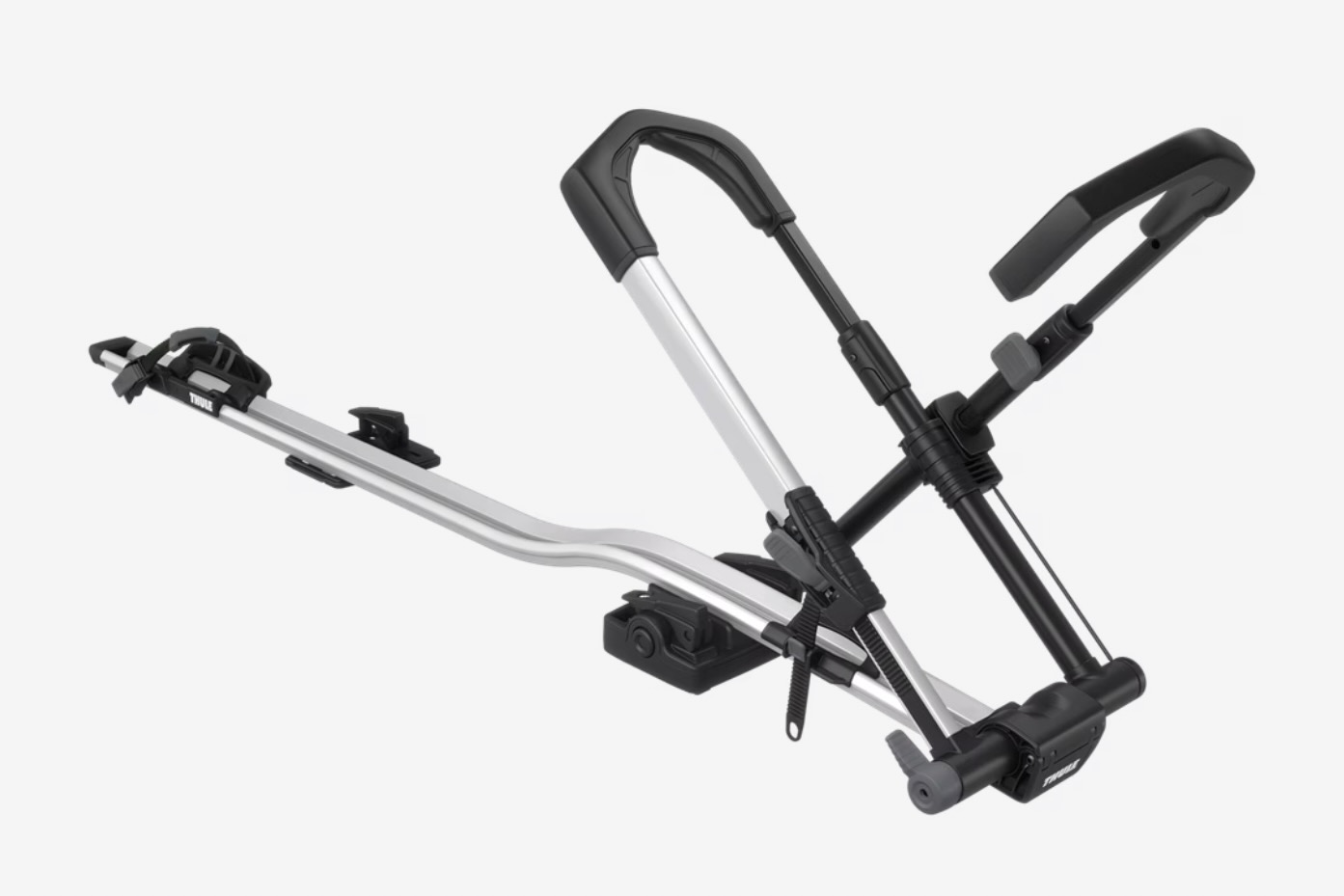
- MSRP: $400
- Type: Wheel on
- Weight capacity: 44 lbs.
- Rack weight: 17 lbs.
- Wheel size compatibility: 20" to 29"
- Max tire width: 3" (up to 5" with Fatbike Adapter)
- Max. wheelbase: 1,300 mm (51")
- Crossbar compatibility: Universal
Pros
- No frame or fork contact
- Secure and confidence inspiring hold of bikes
- No front wheel removal needed
Cons
- Lock cores are sold separately
- Takes a few practice runs to get loading and adjustments dialed

- MSRP: $350
- Type: Wheel-on
- Weight capacity: 45 lbs. on aftermarket bars (35 lbs. on factory bars)
- Rack weight: 19 lbs.
- Wheel size compatibility: 20" to 29"
- Max tire width: 3" (up to 5" with fattie kit)
- Max. wheelbase: 1,220 mm (48")
- Crossbar compatibility: Universal
Pros
- No front wheel removal
- No frame contact
- Bike is stable in use
- A little less expensive than other wheel-on options
Cons
- Some assembly required
- Lock cores sold separately

- MSRP: $599
- Type: Fork mount
- Weight capacity: 35 lbs.
- Rack weight: 10.3 lbs.
- Axle compatibility: 9, 12, and 15mm
- Max tire width: Not specified
- Max. wheelbase: 1,320 mm (52")
- Crossbar compatibility: N/a
Pros
- No crossbars needed
- Fits most cars
- Suction cups are super strong
- App monitors suction pressure for peace of mind
- Fairly easy to install
Cons
- Batteries not included
- An app for your bike rack?
- Suction can be difficult to trust
- Relatively expensive
Roof Bike Rack Comparison Chart
| Roof Bike Rack | MSRP | Type | Weight capacity | Rack weight | Wheel size | Max tire width | Max wheelbase |
|---|---|---|---|---|---|---|---|
| Yakima HighRoad | $349 | Wheel-on | 45 lbs. | 18 lbs. | 26″ to 29″ | 4″ | 1,320 mm (52″) |
| 1Up USA Roof Rack | $270 – $290 | Wheel-on | 75 lbs. | 14 lbs. | 16″ to 29″ | 3″ (5″ w/ Fat Tire Kit) | 1,371 mm (54″) |
| Yakima HighSpeed | $349 | Fork mount | 40 lbs. | 11.5 lbs. | 9, 12, 15mm axles | 5″ | 1,270 mm (50″) |
| Kuat Trio | $249 | Fork mount | 45 lbs. | 7 lbs. | 9, 15mm (12mm sold separately) | 3″ (5″ w/Fat bike adapter) | 1,270 mm (50″) |
| Kuat Piston SR | $598 | Wheel-on | 67 lbs | 26.8 lbs. | 18″ to 29″ | 5″ | 1,346 mm (53″) |
| SeaSucker Talon MAX | $335 | Fork mount | 45 lbs. | 6 lbs. | 9, 12, 15mm axles | 5″ | Adjustable |
| Thule UpRide | $400 | Wheel-on | 44 lbs. | 17 lbs. | 20″ to 29″ | 3″ (5″ w/ Fatbike Adapter) | 1,300 mm (51″) |
| RockyMounts BrassKnuckles | $350 | Wheel-on | 45 lbs. | 19 lbs. | 20″ to 29″ | 3″ (5″ w/ fattie Kit) | 1,220 mm (48″) |
| Allen Smart Suction Rack | $599 | Fork mount | 35 lbs. | 10.3 lbs. | 9, 12, 15mm axles | not specified | 1,320 mm (52″) |
How We Tested Roof Bike Racks
At Bikerumor, we like riding straight from the house whenever possible, but like you, we often drive with our bikes before starting our rides. Having a quality rack to safely and securely transport our precious bikes is a crucial part of our transportation equation.
Not only do we want our bikes to avoid damage during transit, but we also appreciate a rack that is easy to use, stable, and aesthetically pleasing. To that end, we’ve tested most of the roof bike racks on the market to find the best around.
Our Expert Testers
For our roof bike racks buyer’s guide, we recruited cycling expert Bennett Shane to test and compare the majority of the models listed here. Bennett is an obsessive cyclist and cycling gear aficionado who takes great pride in his small fleet of high-end road bikes.
Not only is he meticulous about the condition of his gear, but he has also been cycling seriously for over two decades and has witnessed the evolution of bike racks during that time. Bennett also spent many years working for several prominent brands in the cycling industry and has developed an uncanny depth of knowledge about all things cycling, including bike racks.
Some of the other racks included here were tested by other members of the Bikerumor editorial team. All of our editors are serious cyclists who test gear often, travel frequently with their bicycles, and know the ins and outs of bike racks.
Our Testing Process
After rounding up the best roof bike rack models, Bennett spent months testing them side-by-side. With a set of Thule Wing Bar Evo crossbars mounted to his Subaru Forester, he put most of these racks through the same rigorous testing process.
Each was installed and removed numerous times, and bikes were loaded and unloaded repeatedly. From stop-and-go driving on city streets to highway speeds on the freeway, we examined each rack’s stability and bike security, along with key factors such as bike compatibility, ease of use, security features, and durability.

Buying Advice: How to Choose a Roof Bike Rack
With numerous roof bike rack options on the market to choose from, finding the perfect one can be a challenge. With different bike mounting styles, wheel and tire size compatibility, and weight limits, there are many factors to consider. If a hitch bike rack isn’t for you, our handy guide can help you find the right roof bike rack.
Bike Mount Style
Traditionally, bikes were mechanically clamped into roof racks at the fork dropout, and the front wheel was stored inside the vehicle. Fork mount racks are still an option, but every major brand has developed an alternative style of roof bike rack that allows the front wheel to remain on by grabbing the front tire with a clamping system.
This design saves time getting the bike mounted onto the rack and space inside the vehicle. Overall, wheel-on racks have become the most popular style of roof racks as they are slightly more user-friendly.
Wheel On

Within the wheel-on category, the majority use a clamping arm to secure the front wheel while a ratcheting belt cinches down on the rear rim, which sits close to the tray of the rack. Since the rear wheel is locked in its vertical position by the rear triangle of the frame, this part of the bike doesn’t require as much enclosure as the front wheel.
Generally speaking, these types of racks avoid frame and fork contact, but the strap through the rear wheel will always make contact with your rear rim. The only potential downside is that there is no mechanical attachment between the rack and the bike.
Some brands, like 1Up USA and Kuat, design their racks with clamping arms at both ends. This design allows you to orient the bike in whichever direction you want in the tray and adjust it fore and aft if needed. The dual clamping arm system also makes contact only with the bike’s tires, so there is no frame, fork, or rim contact to scuff up your fancy bike.
Fork Mount

Fork-mount racks are exactly what they sound like. They secure the bike by the fork’s axle and capture the rear wheel on the tray with a strap. Mounting the bike requires removing its front wheel, but it provides a stable and secure mechanical connection between the bike and the rack.
Besides stability, the other main benefit of fork mount racks is that you don’t have to lift the bike quite as high to load it. Since modern bikes come with a variety of different diameter and width axles, most quality fork mount racks come with a few options, or the right size is available as an additional purchase.
Wheel Size, Tire Size, and Wheelbase Length

If you plan to mount a bike with a long or short wheelbase, super-wide tires, or smaller wheels, check the rack’s specs to ensure that it can accommodate your needs. For road and gravel bikes, this won’t be an issue, but for Fat, Downhill, and BMX bikes, it’s important to know the limits of any rack’s compatibility before you buy.
Most wheel-on roof racks have a fairly wide range of fit that can accommodate the wheel and tire sizes of most standard, adult-sized bicycles. If you’re mostly carrying the same bike or type of bike, you usually don’t need to make any changes. When switching between wheel sizes, however, you’ll usually have to adjust the wheel clamps slightly to fit. This is typically a quick and easy process that can be completed without tools on most models.
For fork mount racks, wheel and tire size is much less of an issue, as the bikes are mounted by the front axle of the fork. Axle compatibility is a significant concern here, so ensure you have the correct size adapters for all the bikes you intend to carry.
Again, check the rack’s specifications to see what axle adapters are included. Most brands sell additional axle adapters if the rack doesn’t automatically come with the one you need.
Bike Weight

In addition to dimensions, verify that the rack’s weight limit exceeds the weight of your bike. Generally speaking, the weight limits of roof bike racks are lower than those of hitch bike racks. That said, you also have to lift your bike to roof level to load it onto the rack, so that’s another limiting factor to consider. It can be hard enough to lift and balance a 30-pound bike, so most of us don’t want to hoist a 50-pound eMTB up there anyway.
Most of the roof bike racks we tested have weight limits in the 40 to 45-pound range, which is more than adequate for the majority of road, gravel, CX, and XC/trail mountain bikes. Some long-travel mountain bikes and e-road bikes may exceed the weight limit in certain cases.
Two outliers are the Kuat Piston SR and the 1Up USA Roof Rack, with 67- and 75-pound weight limits, respectively. While it would be challenging to lift bikes that heavy to roof level and would likely exceed the capacity of many crossbars, these weight limits reflect the fact that these racks can be converted to hitch racks with accessories.
Security

Many racks have cable locks built into them for the purpose of securing your bike to the rack and deterring theft. You’ll still want to make sure you can lock the rack to your vehicle’s crossbars to prevent theft of the rack and possibly the bikes that are mounted to it.
So, check to see if lock cores are included in the price or if they are sold separately. More often than not, the racks are designed to accept lock cores, but they do not come with them automatically. Typically, a set of lock cores will add about $75 to the cost of a rack if they are not included.
Crossbar Compatibility

It’s essential to ensure that the roof rack you choose is compatible with your vehicle’s crossbars. Many vehicles have factory crossbars of varying shapes, and while the mounting hardware included with most racks is “universal” and adaptable to most factory crossbars, it’s not a given.
If you are purchasing aftermarket crossbars at the same time as your roof rack, ensure smooth compatibility by selecting the same brand for both the rack and the crossbars. Fortunately, most racks now have almost universal crossbar compatibility, so you can rest assured that with Yakima and Thule crossbars, you’ll be able to mount virtually any roof rack easily. Most manufacturers also list a rack’s crossbar compatibility on their websites, so you don’t need to guess.
If you want a clean look with a mechanical connection between the rack and crossbar, then T-track crossbars are the way to go. T-track cross bars feature a channel that securely holds the mounting hardware, which the rack then threads into, creating a strong hold for driving on rough surfaces and deterring theft of the entire rack system. The only minor downside to this is that it takes a bit longer to remove and install the rack between trips, and you’ll have to keep track of some small parts in storage.

Alternatively, many racks connect to the crossbars with four heavy-duty coated straps that make installation and removal a snap. Many racks are designed to be installed tool-free, assuming they are not going into T-type crossbars. Others will require a common hex tool to clamp the hardware onto the crossbars.
Some racks will also require some assembly prior to installation, but most will be fully assembled out of the box. Plan ahead and allocate about 30 minutes to install and familiarize yourself with the rack’s function before hitting the road.
Suction Racks

A handful of racks attach to the vehicle with heavy-duty suction cups. This style of rack was popularized by SeaSucker and has been around for many years. While the suction cup connection may be disconcerting at first, it has proven to be sturdy and reliable when used properly and attached correctly. They also have the added benefit of being very quick and easy to install, flexible in their mounting location, and highly versatile. They are typically small and lightweight, making them easy to stash in the trunk of your car until you need them. The suction cups will hold onto metal and glass, and can work with vehicles that more traditional roof racks might not fit.
While they are perhaps not the best choice for very frequent use, they are known for being very convenient, and in the case of the SeaSucker Talon MAX, portable enough for air travel. Allen has also joined the suction party with its new Smart Suction Rack. This rack features suction pressure monitors and a smartphone app, allowing you to ensure that your rack remains securely attached to your vehicle. This eliminates the guesswork associated with the suction connection, providing peace of mind.
Loading Height
One of the biggest challenges with roof bike racks is that you have to lift your bike up to the height of your vehicle’s roof to load it. For this reason, roof racks are best suited for use on shorter vehicles like sedans, station wagons, and compact SUVs. This is also a function of your height, as well as your strength and ability to lift and balance a bike while loading it.
Depending on the roof height of your vehicle, some racks will be easier to operate than others. If you have a compact SUV, for example, consider whether a wheel-on rack will allow you to reach and apply downward force to the front arm comfortably. In this case, a fork mount rack with a fork clamp located close to the tray might be a better choice.
Some racks require the application of downforce from a relatively high position, meaning that some users might need to stand on the trim of an open door to gain sufficient leverage to clamp the bike into the rack. Given that you’ll be lifting your bike above shoulder height, this can require a measure of coordination and practice.

Versatility
Not sure if you want a roof rack or hitch rack? A few brands produce racks that can work as either style, provided you purchase the hitch-mounted add-on attachment. Both the 1Up USA Roof Rack and Kuat Piston SR we tested are designed this way, allowing folks who purchase these racks to adapt the rack if their storage needs or vehicle changes in the future.
In the case of the Piston SR, Kuat offers a 2-inch hitch adapter ($198) that converts it into a single-bike hitch rack. For the 1Up, you can purchase a 1.25-inch ($232) or 2-inch ($255) Single Hitch Assembly, or a 2-inch Double Hitch Assembly ($355) that can convert two roof racks into a double hitch rack.
Additionally, both the 1Up USA and the Kuat Piston can be mounted horizontally to the back of campervans. This allows for custom rack setups above other cargo boxes, etc. We’ve even seen some people mount the 1Up vertically on the back of vans, although Kuat specifically does not recommend that for the Piston SR.

Durability
While many racks use plastic hardware that can degrade and fail after years of exposure to harsh conditions, more companies are beginning to offer fully metal designs with tougher finishes that will probably outlast most cars. We applaud this because it keeps racks where they belong — on the road and out of landfills — and saves a ton of money in the long run.
Realistically, any of the racks on our list will last quite a long time, but the 1UP-USA Roof Rack will outlast all of them. With a completely metal construction, replaceable hardware, and a full suite of replacement parts available, 1UP wants you to get your money’s worth. These racks will seriously outlast the vehicles you use them on.
Kuat is also bringing some serious durability to the table with the Piston SR. Yes, this rack is expensive, but it also has an almost completely metal construction and robust build that can handle more weight and abuse than other roof racks. It also has a great-looking and super-durable finish that is very resistant to road spray and corrosion.

Price & Value
Compared to hitch-mounted options, roof bike racks are generally quite a bit less expensive, but there’s still a pretty wide range in price. Considering the fact that each roof rack can only carry one bike at a time, you may need to purchase more than one if you need to haul two or more bikes. Additionally, if you need to purchase crossbars and lock cores, the cost can add up pretty quickly. It’s worth adding up the total cost and comparing all of your bike rack options to see what works best for your budget.
Budget
When it comes to transporting bikes, we don’t think that buying the cheapest rack possible is the best idea. Sure, you can find very inexpensive roof racks that cost around $100, but they’re poorly made, unstable, and insecure, and will likely damage your bike’s frame and paint over time. This is why the least expensive models we recommend are around $250 to $300.
Just because these racks cost less than the others we tested doesn’t mean they don’t work well. Kuat’s Trio ($249) fork-mount rack has a sleek look, holds the bike very securely, and even comes with an integrated cable lock. For modern road and gravel bikes, you’ll need to purchase a 12 mm thru-axle adapter separately, but it still costs less than the competition.
While we wouldn’t call it “budget”, the 1Up USA Roof Rack ($270 to $290) is a great value. It has a durable, all-metal construction that will likely outlast the vehicle you mount it on. It’s also highly adaptable and can be converted to a hitch-mount rack or even mounted to a campervan or overlanding rack if your needs change.
Mid-Tier
Most of the roof racks on the market fall into the middle of the price spectrum at around $300 to $400. In general, we see improvements in aesthetics, materials, or user-friendliness. Yakima’s HighRoad ($349) gets our nod for the best overall roof rack because it is so easy to use. This is particularly important with roof racks, given how awkward it is to lift your bike to roof height and secure it in a rack. The front-wheel clamping system and TorqueRight knob provide a hassle-free experience. The same is true of the Yakima HighSpeed ($349) fork-mount rack. The fork attachment system and TorqueRight knob make loading bikes just a little easier.
Premium
While it is arguably the highest-quality and best-performing roof rack on the market, the Kuat Piston SR ($598) is likely priced out of reach for many. That said, the premium price buys you a rack with a finish quality and ease of use that are through the roof (on the roof?).
With hydraulically actuated, ratcheting front and rear wheel clamps, loading and securing your bike is incredibly easy. Additionally, its tire-hold design avoids contact with your frame and rims. Like Fox’s top-tier suspension components, the gold Kashima coating on the pistons surely adds to the price, but the rest of the build is just as impressive. The powder coat finish is as visually appealing as it is durable, and the automotive-grade hardware ensures you get your money’s worth. Similar to the 1Up Roof rack, the Piston SR can also be converted into a hitch rack by purchasing an adapter.
Frequently Asked Questions
Which bike attachment style is better kinda depends. Both have their advantages, so it’s really up to the user to decide what’s best for them and the bikes they carry. Wheel-on racks are user-friendly in that you don’t have to remove the front wheel to load the bike or store the front wheel in your vehicle.
That said, you do have to lift the bike slightly higher to load it, which can make the process more challenging depending on your height, strength, or the height of your vehicle’s roof. They also tend to be slightly less stable overall than a fork mount, but not enough to be problematic.
Fork-mount racks require the front wheel to be removed, and you need to keep the wheel somewhere in your vehicle in transit. You also need to be sure you have the correct size adapter to fit your bike’s front axle size. The positives are that the mechanical connection of the rack to the fork axle is very stable, and you don’t have to lift the bike quite as high to load it.
Cycling is an expensive sport, and it only seems to get more expensive with each passing year. It’s not just bikes, parts, and accessories either, it’s across the board, including bike racks. Compared to most hitch-mount bike racks, roof racks are comparatively less expensive, but that doesn’t mean they are cheap.
After all, we trust these things to hold our bikes safely and securely on top of our vehicles at highway speeds. For that reason, buying the cheapest roof back rack you can find isn’t something we necessarily recommend.
Still, there’s a pretty big range in price of the racks we tested, from around $250 up to $599. What does shelling out the big bucks for the Kuat Piston SR get you? We’ll start by saying that the Piston SR is the most advanced design of all the racks we tested. The hydraulic One-Tap piston arms make using it much more user-friendly than similar racks.
It has a huge range of bike fit and a higher weight limit than most. It can also be converted to a hitch rack if you choose. The construction is also bombproof, as it’s made almost entirely of metal and has a durable powder-coat finish that should look great for years. This rack is an investment in great design, functionality, and durability.
Do you need to spend that much? Absolutely not, but you can if you want to. You could just as easily spend $270 for the 1Up USA Roof Rack and get a rack that functions similarly and will last at least as long with minor sacrifices in user-friendliness. Ultimately, it’s up to you to decide what you’re willing to spend.
Many roof bike racks will work with fat tire bikes, meaning tires up to around 5 inches wide. Some racks will require purchasing a special adapter kit to accommodate tires or axles that wide, but manufacturers typically offer them at fairly reasonable prices.
The Thule UpRide, RockyMounts BrassKnuckles, Kuat Trio, and 1Up USA Roof rack can all be adapted to work with fatter tires. Straight out of the box, the Kuat Piston SR is capable of handling tires up to 5 inches wide and changes to wheel size are also super easy with the tool-free adjustment.
Some lightweight electric bikes may fall within the weight limits of some roof bike racks, but generally speaking. roof bike racks are not the best way to transport e-bikes. Even if your roof rack can handle heavier bikes, like the 1Up and Kuat are rated for, you’ll need to consider the weight limitations of your factory or aftermarket crossbars.
Lifting heavy bikes to roof height is probably the biggest concern, as it can be very challenging for most people to raise and balance a 50+ pound bike up that high. If you have electric bikes, we recommend hitch bike racks as the best way to transport them. Hitch racks have lower loading heights and higher weight limits, and some can even be used with loading ramps to get your e-bikes into position.
Most roof bike racks are pretty compact when they are folded down and not carrying a bike, so leaving them all of the time isn’t too big of a deal for most people who use them frequently. If you use your rack infrequently, or you simply prefer the look of your vehicle without the rack when it’s not in use, then removing it between uses may be a consideration.
Most racks involve a few bolts that need to be tightened to secure them on or around the crossbars, so it typically involves a tool and about 10 minutes to install or remove them from the vehicle. The exception to this rule and the easiest to install/remove of all the racks we tested are the Yakima HighRoad and Yakima HighSpeed. Both racks use a tool-free strap system that makes it quick and easy to mount them up for use when you need them.
Related Content
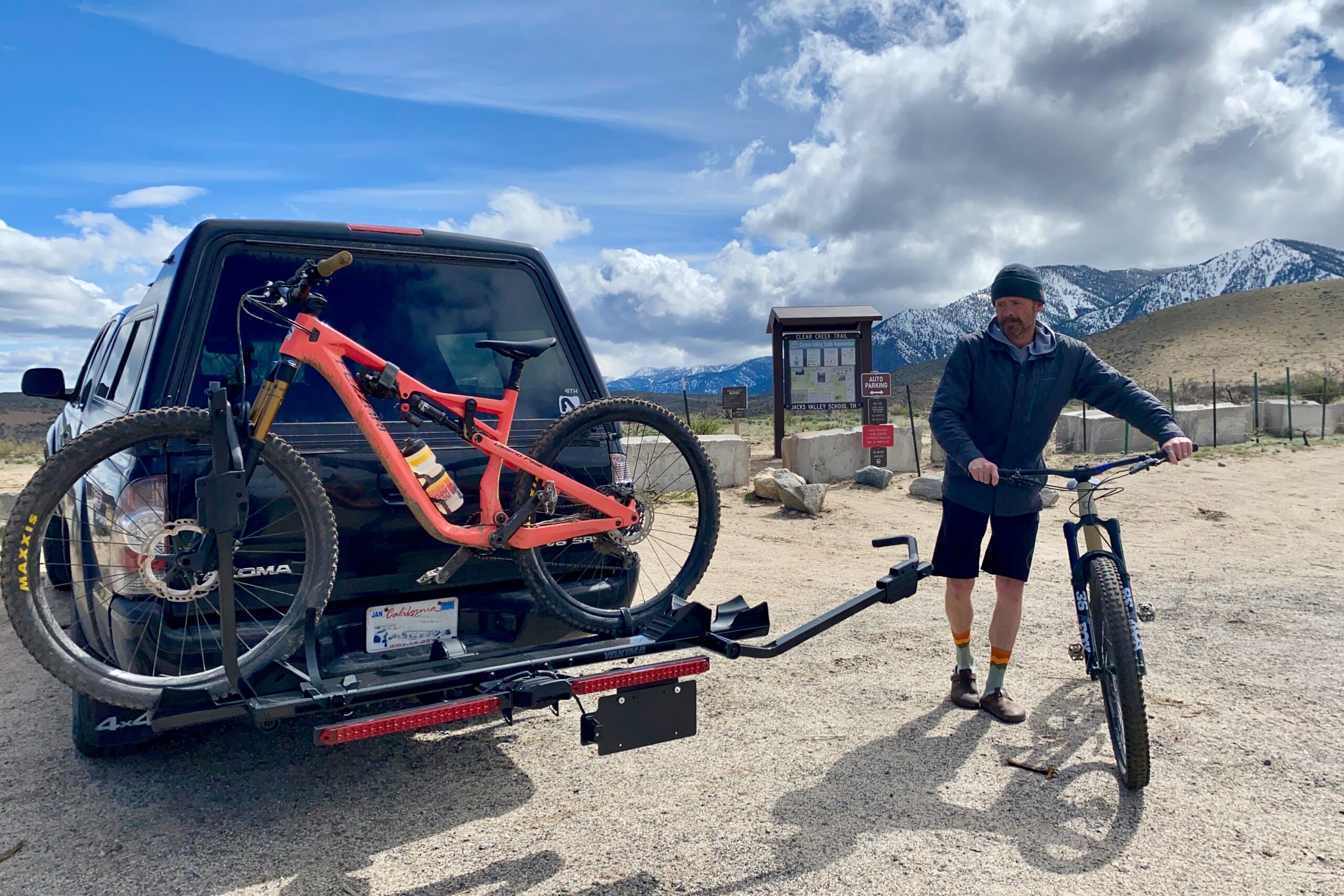
The Best Hitch Bike Racks of 2026
We’ve tested 15 of the best hitch bike racks available in 2026 to help you find the model that best suits your needs and budget.
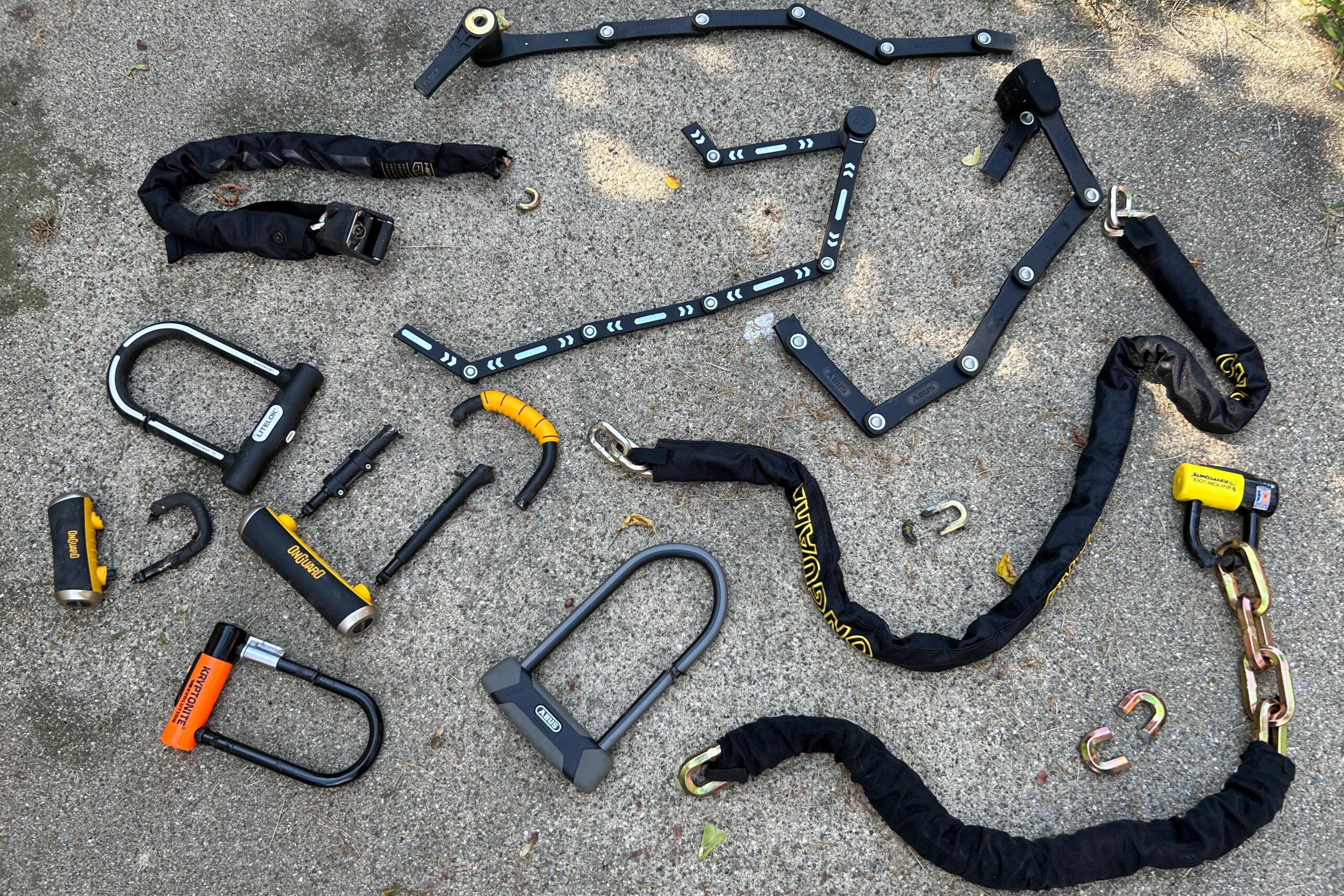
The Best Bike Locks of 2026
We tested 13 of the best bike locks on the market to help you find the best options to keep your bikes safe and secure.