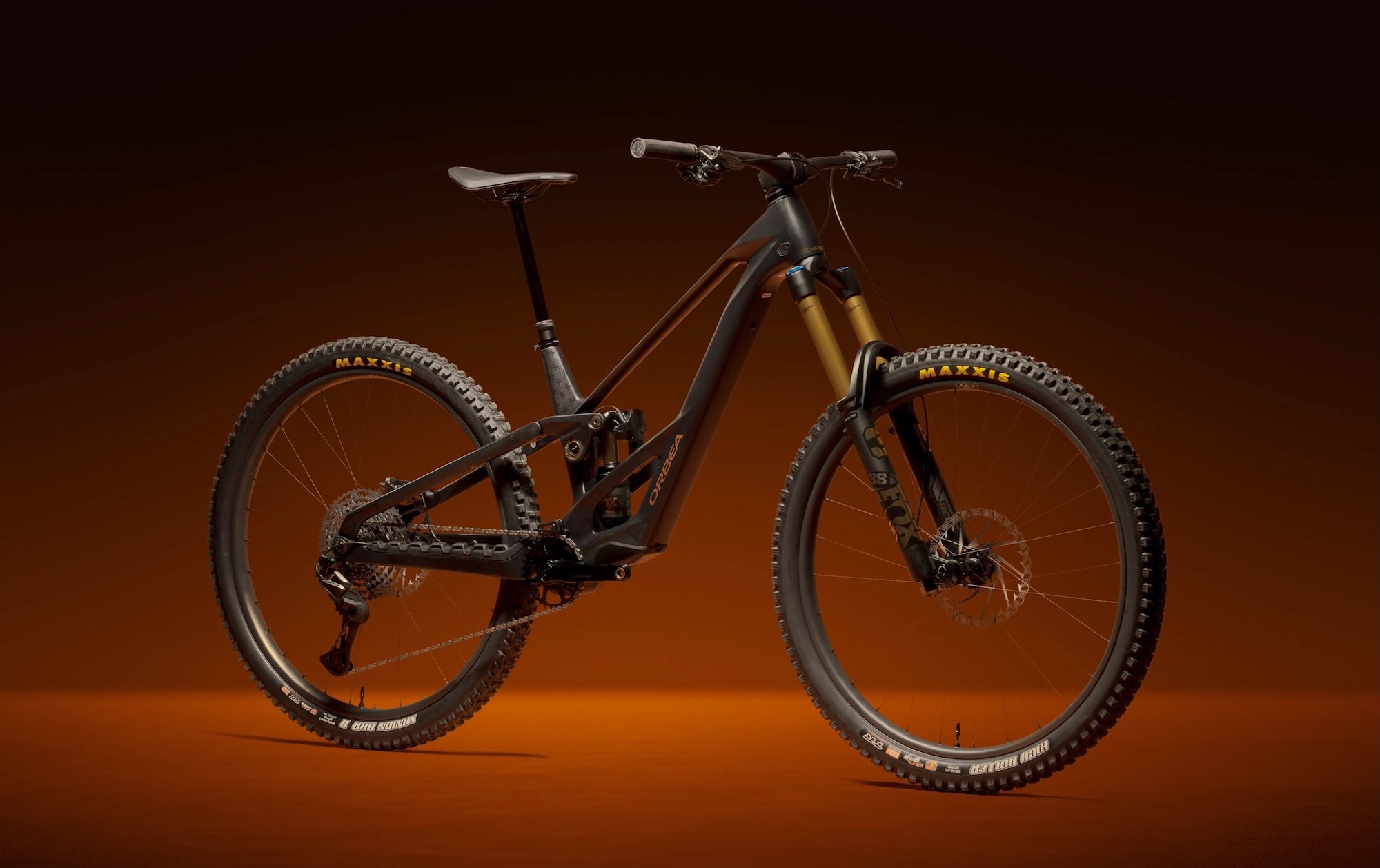


Today, Orbea announces the new Rallon RS eMTB. While it could easily be confused with the latest non-electric Rallon enduro bike, Orbea added a light drive system to it, and at the same time, took its RS Control System integration to a new level. Orbea states that the Rallon RS “was built to ask questions, push boundaries, and explore a different path forward for mountain bikers,” and the result is “a bike that marks a bold new direction for the industry.” This is not your typical eMTB.
Built around the long-travel Rallon enduro platform, the RS is equipped with the compact TQ-HPR40 drive system to provide “assistance that never exceeds the rider’s own input.” In fact, Orbea says they “do not describe the Rallon RS as an e-bike, but as a trail bike that represents the next step in mountain bike development.” That’s quite a statement, and along with the expansion of the brand’s RS Control System integration, there’s a lot to unpack on this unique new eMTB. Let’s check it out.
Orbea Rallon RS Details
The Rallon RS is based on the non-electric Rallon enduro bike that launched last year. In fact, the OMR carbon frame looks nearly identical, despite housing a compact drive unit and battery in the downtube. We’ll get into the details of the TQ-HPR40 drive system later, but we’ll point out here that its compact size allowed Orbea to maintain a silhouette almost indistinguishable from the analog version, including the split-pivot suspension design. However, the motor and battery appear to negate the use of the GravityLinks and adjustments on the non-electric version.

Like the non-electric Rallon enduro bike, the Rallon RS frame features 170mm of rear wheel travel, paired with a 180mm fork. It is sold with dual 29” wheels or in a mixed wheel configuration. A different linkage maintains the bike’s geometry when switching between rear wheel sizes, which Orbea sells separately for those who like to mix it up. A geometry-adjusting flip chip changes bottom bracket height by +/- 8mm and head angle by +/- 0.5 degrees. Lastly, a headset adjustment allows further geometry customization with head angle adjustment of +/- 0.75 degrees.

Beyond those adjustments, the RS’s geometry closely mirrors that of the standard Rallon. The key figures include the 64.25-degree head tube angle, 445mm chainstays on all sizes, and a steep effective seat tube angle. The provided geometry chart lists the effective seat tube angle as 74.6 degrees, but it looks much steeper than that and the normal Rallon’s angle is listed at 79 degrees. Regardless, the bike comes in four frame sizes, S-XL, and Orbea states that even the small and medium frames can fit a 210mm dropper post.

The frame has mounts for one bottle cage in the front triangle, which can be used to carry water, obviously, or to hold the optional range extender. Even with the TQ-HPR40 motor, 290 Wh battery, and other electronics, Orbea says that the RS version is only 1.3kg heavier than a standard Rallon. Unfortunately, complete bike weights were not shared with us, but we’d expect them to be in the neighborhood of ~40 pounds (18 kg).
Drive System and Battery
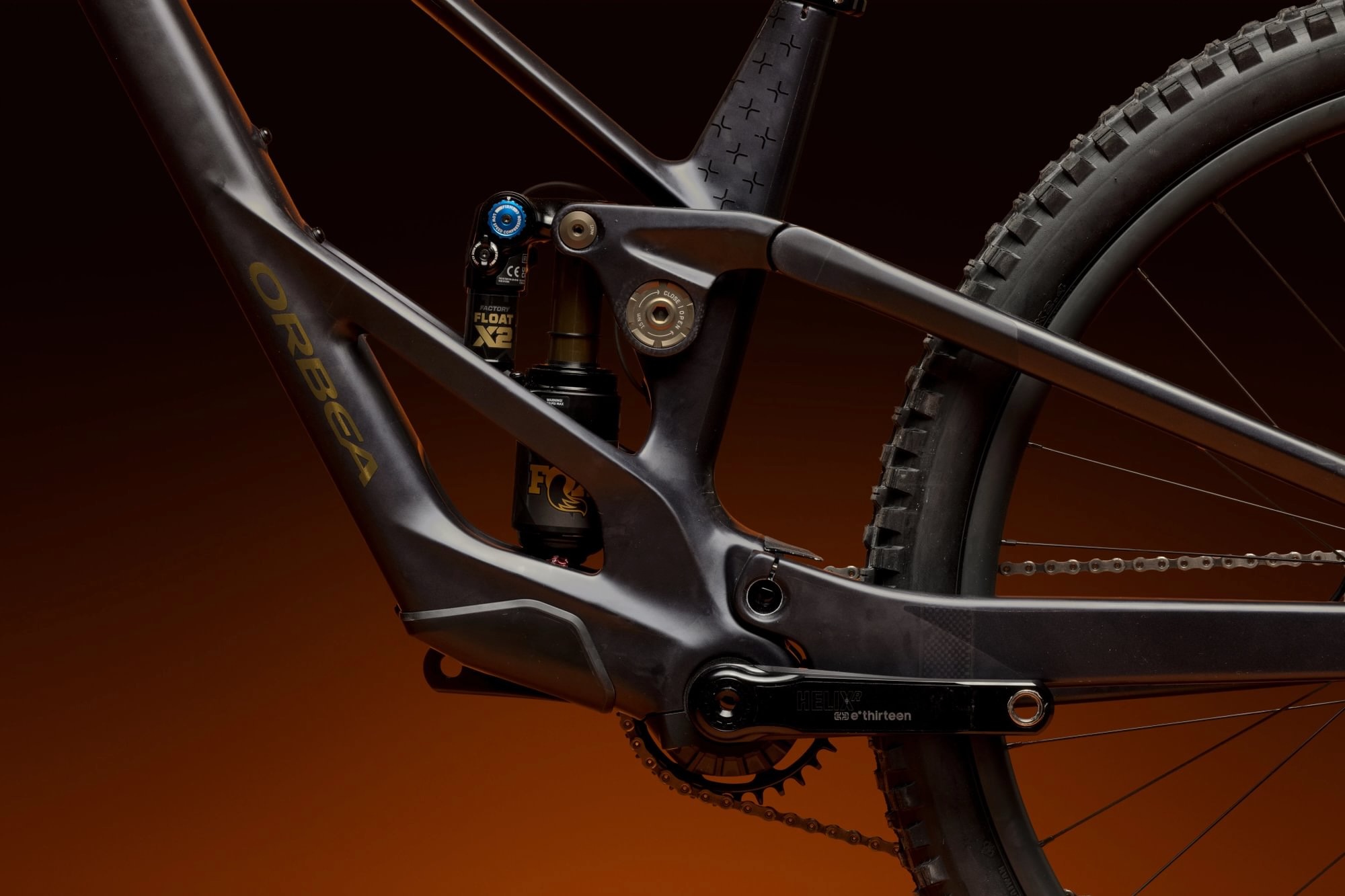
With the new Rallon RS, Orbea refers to the pedal assistance as a “subtle helping hand.” It seems the idea was to take a bike-first approach and not let its e-bike-ness dominate the ride experience. According to Orbea, “The objective was to improve the pedalling feel on climbs by reducing the usual compromises that come from the extra weight of a long-travel chassis and the rolling resistance of aggressive tires.”
To that end, Orbea chose the compact and lightweight TQ-HPR40 drive system to provide the pedal assistance. We’d be lying if we said we weren’t a little surprised that they didn’t choose the mid-power HPR60, which has received very high praise and is used on bikes like the new Yeti MTe. That said, the HPR40, which is more common on e-road and e-gravel bikes, seems to align well with the objective described above. With up to 40Nm of torque and up to 200W of peak power, it’ll provide a little boost but a more natural ride feel for those who “want just enough support to maintain flow without losing the satisfaction of pedaling.”

For comparison, the latest crop of full-power eMTBs are putting out more than double the peak power and torque. The Avinox is still the power leader with 105 Nm of torque (up to 120 Nm in Boost) and peak power of 1,000 W. The popular and relatively common Bosch CX motor is now up to 100 Nm of torque and 750 W of peak power. With that much power, those motors can provide an entirely different ride experience than the HPR40 on the Rallon RS. But Orbea is one of the pioneers of the SL e-bike category, so we expect they knew exactly what they were trying to accomplish with the smaller, efficient, lower power motor.
Providing the juice for the HPR40 motor is a 290 Wh battery that frankly doesn’t even look like it’s there. Given that lower-power motors like the HPR40 use less less power, Orbea claims the modestly-sized battery provides an impressive range of 1200 to 1800 meters of climbing. That range can be increased by adding battery capacity with an optional 160 Wh range extender, which provides 55% more battery for longer rides.
RS Control System Integration

Last year, Orbea introduced its RS Control System, which debuted on select models of its Rise eMTBs. At that time, the RS system included the new RS Smart Dropper, an integrated handlebar unit that controlled both the drive system and dropper, and connected everything to the bike’s main battery. In our press materials, Orbea also refers to the controller as the RS-HMI (Human Machine Interface).
With the new Rallon RS, Orbea takes that system integration further by connecting the remote, motor, derailleur, dropper post, suspension, and battery together. According to Orbea, “Sharing power simplifies charging and reduces clutter, and their proprietary communications system enables all the components to share information, a totally new concept that creates new possibilities.”

Orbea says the updated system allows riders to control the bike’s motor, suspension profiles, and dropper post from a single handlebar-mounted unit with customization through its own RS Connect App. To achieve this, Orbea says it invited both Fox and TQ to join them and that they “recognized the potential to push their own technologies further and agreed to open development.” Now, Orbea’s RS technology works with the proprietary Fox Live Valve Neo shock, the TQ motor, and the Orbea RS dropper to share information and enable the following capabilities.
- Suspension informed by motor data: The shock receives inputs such as cadence, rider power, motor power, and bike speed from the TQ motor. Orbea’s custom algorithms use this data to deliver more predictable and responsive suspension behaviour.
- Suspension informed by dropper position: The MC10-RS dropper communicates its exact position multiple times per second through an optoelectronic Time-of-Flight sensor. This is an industry first. When the dropper is lowered, the shock stays fully open to optimise downhill performance.
- Motor behaviour adapted to terrain and rider position: The TQ motor recognises when the bike is pointed downhill with the dropper lowered and adjusts its assistance to avoid unwanted inputs in technical terrain.

Orbea Rallon RS: Build Options and Pricing
The Rallon RS currently comes in two build options, with both available with 29” wheels or in a mixed-wheel configuration. As mentioned above, the RS Control system is designed to integrate with a proprietary Fox Live Valve Neo shock, which comes spec’d on the top-tier LTD builds. The Team builds do not come with the Live Valve shock, but it is listed as an upgrade option for the low price of $1,049.
Either way, the new Rallon RS comes in either Frozen Concrete Gloss or Fuel Carbon View colorways, or buyers can design their own in Orbea’s MyO customizer. At checkout, you can also purchase the 160Wh range extender for $525, upgrade from EXO+/DD to DH casing tires for $40, and the mullet or 29” linkage for $265.

Orbea Rallon RS-LTD: $14,999
- Fork: Fox 38 Float Factory 180, Grip X2
- Shock: Fox Float X2 Live Valve Neo Factory Trunnion Evol
- Drivetrain: Shimano XTR Di2
- Cranks: e*thirteen Helix Race alloy 32T
- Brakes: Shimano XTR M9200
- Wheels: Oquo Mountain Control MC32LTD (MX or 29”)
- Tires: Front: Maxxis High Roller III 2.40″ EXO+ MaxxGripp, Rear: Maxxis Minion DHR II 2.4” DD MaxxTerra
- Dropper: OC Mountain Control MC10 Electronic
- Saddle: Fizik Terra Ridon X1 145mm
- Handlebar: OC Mountain Control MC10 Carbon, Rise 20, Width 800
- Stem: OC Mountain Control MC11 Alu SL, 0º
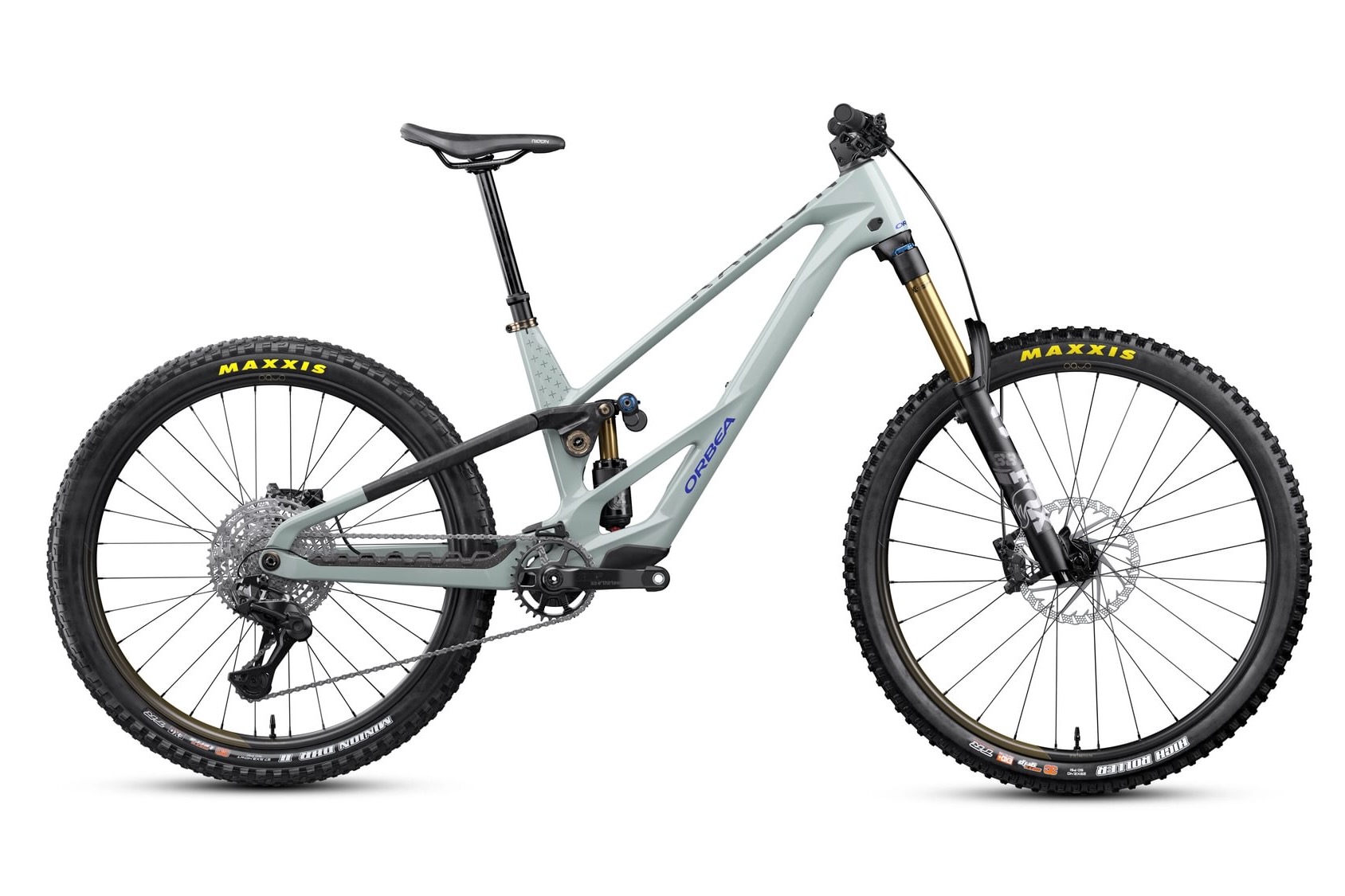
Orbea Rallon RS-Team: $10,999
- Fork: Fox 38 Float Factory 180, Grip X2
- Shock: Fox Float X2 Factory Trunnion
- Drivetrain: Shimano XT Di2
- Cranks: e*thirteen Helix Race alloy 32T
- Brakes: Shimano XT M8220
- Wheels: Oquo Mountain Control MC32TEAM (MX or 29”)
- Tires: Front: Maxxis High Roller III 2.40″ EXO+ MaxxGripp, Rear: Maxxis Minion DHR II 2.4” DD MaxxTerra
- Dropper: OC Mountain Control MC10 Electronic
- Saddle: Fizik Terra Ridon X5 145mm
- Handlebar: OC Mountain Control MC10 Carbon, Rise 20, Width 800
- Stem: OC Mountain Control MC11 Alu SL, 0º

Orbea Rallon RS: Availability
Orbea seems to be charting its own path with the new Rallon RS, aiming to make the most integrated, but least e-bike-like, eMTB. That’s sure to resonate with some riders, and rule out plenty more. But as the eMTB market continues to mature, we’re seeing more options to suit specific use cases, riding styles, and preferences. It’s clear that Orbea had a specific goal with this bike, and we’re certainly curious to know how it rides.
Arguably the most interesting aspect of its design, however, is the expansion of its RS Control System. This marks a new level of system integration and points to a future in which all of our bikes’ electronics operate as a connected system. With the new Rallon RS, it seems that the future is now, for Orbea anyway.
The new Orbea Rallon RS bikes are available now. Head to the Orbea website to learn more or pick one up for yourself.


