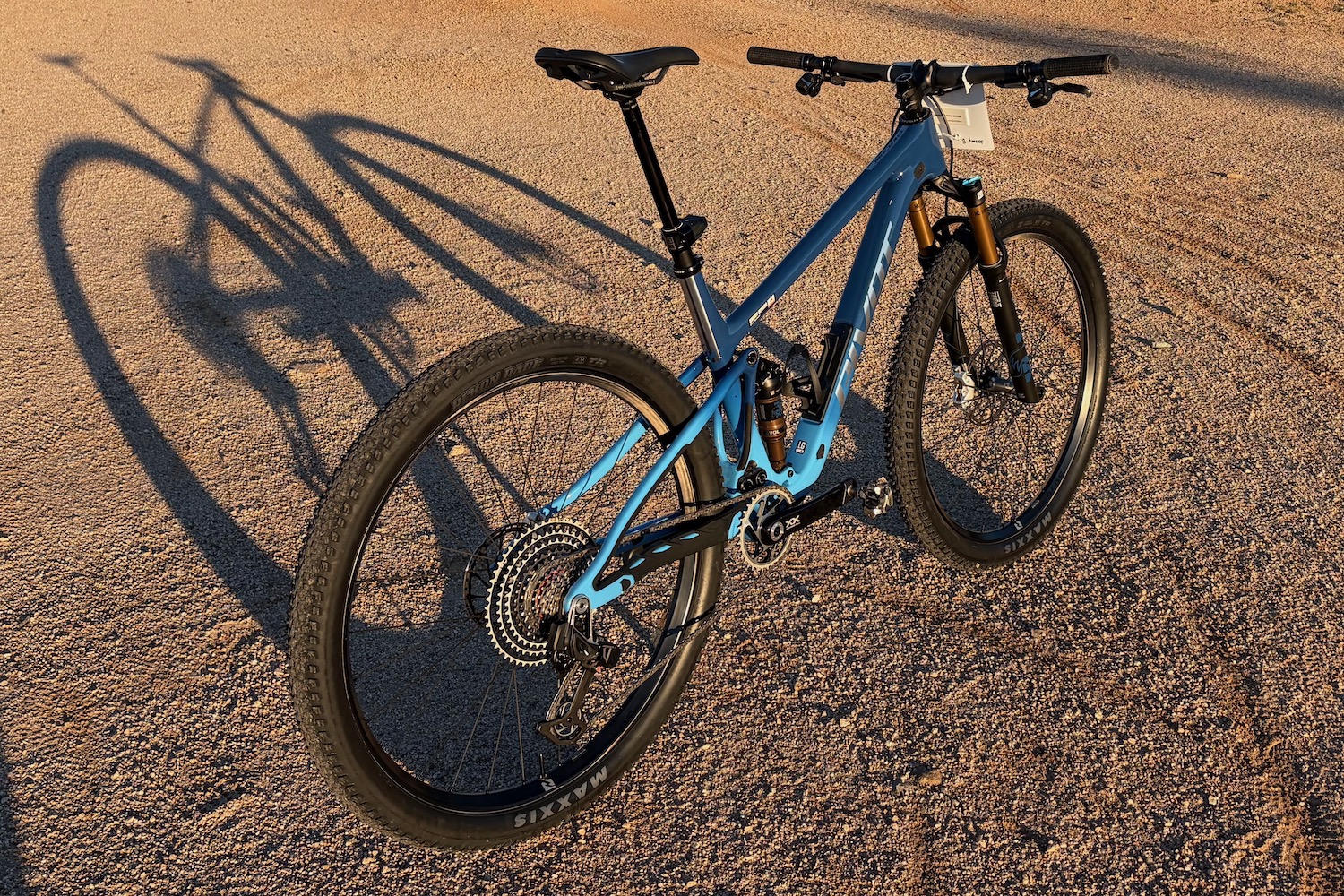


Today, Pivot launched an updated version of its full suspension cross-country bike, the Mach 4 SL. Back in January, Pivot invited members of the cycling media to come and check out the soon-to-be-released Mach 4 SL, and they added a little twist. They gave us all the option to enter the McDowell Meltdown XC race, the first stop in the Mountain Bike Association of Arizona’s 2026 race series. It was a bit of an unorthodox approach for a press event, but a real trial by fire to see how the new XC bike performs in an actual XC race.
Despite my concerns about my middling mid-winter fitness, I had them sign me up for the 22-mile race in the expert class. I arrived the day before, and we got the bikes set up at Pivot HQ, but other than a few laps around the parking lot, the race would be my first experience riding the new Mach 4 SL. It would also be my first time riding any of these trails, so along with a few other media folks, it was bound to be an interesting morning and quite the introduction to the new bike.
Trial By Fire

Despite professing my love of eMTBs somewhat regularly, I’m actually quite obsessed with maintaining a high level of fitness on the bike. I really enjoy pushing my body to its limit as much as possible, including in a handful of endurance gravel and mountain bike events each year. However, the races I participate in typically take place in the summer, and until the Mach 4 SL press camp, I’d never even considered racing in January. My fitness usually hits rock bottom around the New Year, since it’s often cold and snowy where I live.
But this winter has been particularly mild, and I’ve been able to maintain a respectable fitness level mostly riding outdoors, with only a couple of weeks on the trainer. Still, I’m nowhere near my peak — not even close — so I set my expectations as low as I possibly could. Add in the fact that it was my first ride on a brand new bike on trails I’ve never ridden before, and it was a recipe for trying to have a good time rather than setting the leaderboard on fire.

So, shortly after sunrise, we lined up to take on 22 miles of desert singletrack at the McDowell Mountain Regional Park just outside of the Phoenix Metropolitan area. The course was probably 95% singletrack and properly cross-country, with lots of short, punchy climbs and fast descents, with smooth sandy stretches broken up with chunky technical sections and desert washes. Fortunately, Pivot set us up with full Pivot team kits that happened to match my shoes and the bike, so I looked pro-ish, even with my unshaven legs (gasp) and a helmet with a visor (pretty clutch for the early-morning January sun angles).
Despite my intention to take it easy, my competitive nature got the best of me, and I started fairly quickly and was pretty maxed out within the first half mile. I settled into the conga line and was happy to just sit in with a wheel to follow through the twisty and punchy trails that were completely new to me. The pace was fast, the trails were fun, and to my surprise, I didn’t think twice about the bike that I was riding. Normally, it takes me a few rides to adjust to a new bike, but I was super comfortable on the Mach 4 SL right out of the gate, er, starting line.

I gave it a solid effort and finished the 22-mile course with ~1,800 vertical feet of climbing in 1:36:24, averaging 13.7 mph. That turned out to be good enough for 5th place in the Expert 40-49 category. Apparently, Arizonans are quite fit mid-winter. And while I couldn’t help but be slightly disappointed with my result, I was very impressed with the Mach 4 SL. I don’t typically average more than 13 mph riding singletrack, especially not in January. This bike is a rocket.
Pivot Mach 4 SL: Ride Impressions

The day after the XC race, we took the Mach 4 SL for a cross-country loop on the lower trails on South Mountain, just up the road from Pivot HQ. The trails were typical of the area, with smooth sections interspersed with super chunky technical sections, punchy climbs, and no shortage of spiky trailside obstacles to avoid. The pace was casual, and we snapped some photos while getting to know the bikes outside of the race course. Still, I’ll point out that my experience on the Mach 4 SL is fairly limited, and these are just my first impressions from a couple of rides.
Climbing and Pedaling Efficiency

As mentioned above, this bike is fast. Heck, it looks fast standing still, but it also rolls very quickly, and it really does feel incredibly efficient. I think one of the main reasons is Pivot’s use of the DW-Link suspension design. Yes, that adds some weight compared to featherlight flex-stay bikes, but it works really, really well. I don’t have the exact anti-squat numbers, but I can attest that it is very supportive, calm, and stable under pedaling forces. I’d go so far as to say that it almost feels as if it pushes back against you when you really put the power down.
At the same time, the suspension seems to separate pedaling and external inputs well, and I found traction to be ample at the rear tire. It didn’t seem prone to hanging up in techy sections, nor did it strike me as the plushest or most supple, but it’s a 120mm-travel bike tuned for efficiency. One thing that stood out immediately, however, was the frame’s tight, stiff feel. I think the frame’s sturdy, stiff, and precise feel is another benefit of the DW-link design — but that comes with a little bit of a weight penalty, of course.

The size large frame was very comfortable for me at 6’0”, and I think it hits the “modern XC” sweet spot. The 470mm reach sounded a touch short at first, but when paired with the XC-oriented 75-degree seat tube angle, I felt right at home when seated pedaling. While the stack height is low compared to a trail bike, it didn’t feel quite as low or aggressive as some other XC bikes I’ve ridden recently. Don’t get me wrong, it felt aggressive enough, but not over-the-top racy. Bar height could be easily adjusted with spacers to suit individual preferences, too.
Descending

XC bikes have changed quite a bit in recent years, and that’s most evident in their enhanced downhill capabilities. Geometry is the largest variable in that equation, and it seems like Pivot did a good job refining the Mach 4 SL’s angles and measurements to keep it sharp and responsive while enhancing stability and composure on the descents. Reach and head tube angle are the places that changed the most from the previous version, with 66 degrees and 470mm (size L) feeling perfectly up to date and in line with today’s standards.
I found the Mach 4 SL to be very responsive to steering inputs, with the stiff frame reacting quickly to weight changes and pressure on the handlebars. It felt super quick and plenty nimble, without being twitchy or nervous. It entered and exited turns predictably, and I felt its trail manners, geometry, and suspension felt well-balanced. I only rode with it in the 120mm travel setting, which felt great on the variable desert terrain we rode, and paired well with the 120mm travel fork. For everyday riding, I’d be very inclined to swap out the fork’s airshaft to bump the travel to 130mm. I think that would provide a bit more cushion and a ~0.5 degree slacker head tube angle, turning the Mach 4 SL into more of a superlight trail bike.

With just two rides, I didn’t get to experiment with the suspension settings much, but it took everything I threw at it in stride. This included some sketchy mid-race rock garden lines, a blind drop or two, and some relentlessly chunky sections of lower South Mountain. Obviously, a 120mm travel XC race bike has limitations and won’t be the most forgiving, but it absolutely held its own, didn’t flinch, and inspired confidence to let it run and push the pace. Like most XC bikes, it has the geometry to rip as hard as you’re willing for its travel numbers.
Weight

The elephant in the room with the new Mach 4 SL is undoubtedly going to be its weight. It’s still a light bike, but the ~2,500 gram frame/shock weight is “heavy” compared to the lightest bikes on the race circuit. That said, Pivot didn’t set out to make the lightest bike possible; they made a bike with the performance and features they wanted. Still, I think the 24.8-pound-ish weight of my Team XX SL test bike is very respectable, and it would be fairly easy to make it lighter with a shorter travel cable-actuated dropper and some other component changes. The 200mm Reverb AXS post on my test bike is one of the heaviest options available and has more travel than anyone realistically needs on a race bike

I could take or leave in-frame storage on an XC race bike, but I understand why they felt the need to add it as a feature. Many riders might choose the Mach 4 SL as their everyday ride, and for those putting in big miles or doing marathon-style races, it might be nice to have their essentials tucked neatly away inside. But along with the DW-Link design, that feature adds to the overall weight of the Mach 4 SL.
So, while I’m sure that many will scoff at its weight, I think that Pivot’s design choices, and the resulting weight of the Mach 4 SL, bring something a little different to the table compared to most XC bikes. It has a robust feel and sturdiness that some lighter bikes often lack, and it’s really not that heavy to begin with.
Build

I tested the Team XX SL build, which retails for $11,999. Unless you want Flight Attendant suspension, I’d say this component spec is about as good as it gets and is perfectly dialed for the Mach 4 SL’s intended use. It was also brand-spanking-new when I rode it, and everything worked perfectly from the drivetrain to the brakes, suspension, etc. Based on my experience, this bike is race-ready straight out of the box, with no upgrades or changes needed — except maybe the touchpoints.
I think it’s also worth mentioning how quiet it was. Beyond the sound of the AXS motor in the derailleur, my test bike didn’t make a sound during the two days I rode it. No chainslap noise, no cable rattle, basically all I could hear was the sound of my tires on the ground and myself hyperventilating in the race. It seems like Pivot knows that perfection is exactly what you should expect from a bike at this price point, and that’s what they deliver.
My Takeaway

My time aboard the new Mach 4 SL was short, but it was a fast and furious introduction to Pivot’s latest XC race bike. My first impression is that it’s a super-fast, efficient, and capable cross-country bike designed to handle the rigors of modern race courses. Its travel and geometry are dialed, and its DW-link suspension design brings something different to the table compared to the latest crop of flex stay bikes.
It’s a tad heavier than some of its direct competitors, but with that comes a sturdy ride feel, in-frame storage, and a bike designed purely around performance instead of weight targets. It strikes me as race-ready, but capable enough to be more than just a pure race bike.
I’m hoping to get my hands on a Mach 4 SL for long-term testing over the coming spring and summer, possibly even for another race. I’ll report back with a review in a few months if it all works out.
Head to your local Pivot dealer or the brand’s website to check out the new Mach 4 SL.


