Home > Bike Components > Tires

Vittoria Air-Liner Light Road Gives You 50km of Run Flat Protection

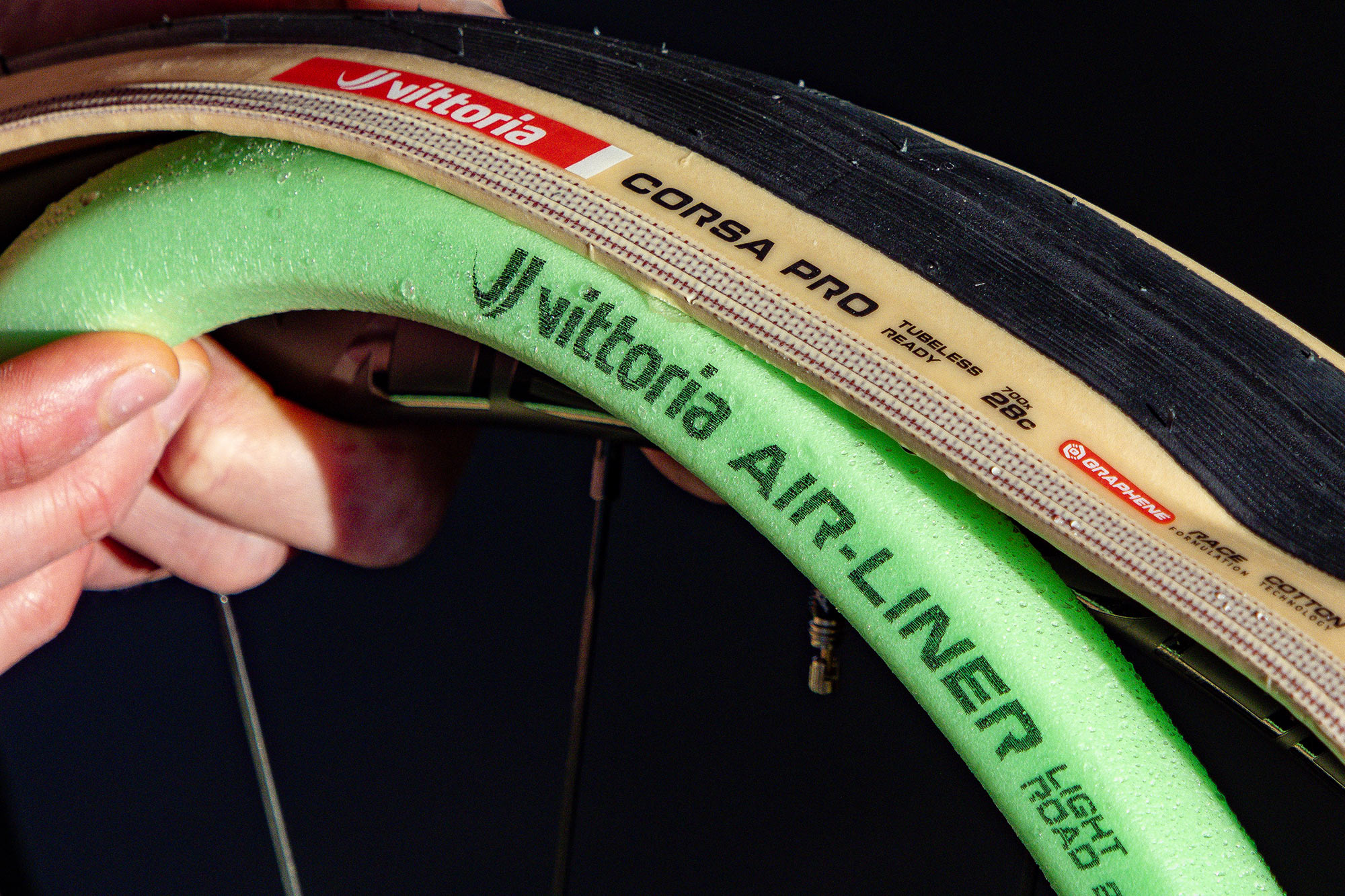
Vittoria-Air Liner Light-Road bike run flat tire insert being installed.
14 Comments
Support us! Bikerumor may earn a small commission from affiliate links in this article. Learn More

Get a flat but finish the race without stopping? Yeah, that used to be a badge of pride for cyclocross racers, now it’s something anyone can do on their road bike.

Vittoria’s original Air-Liner Light Road added their same “run flat” technology to tire inserts for skinny tires, and now it gets an upgrade that makes it easier to install and have less impact on your sealant.
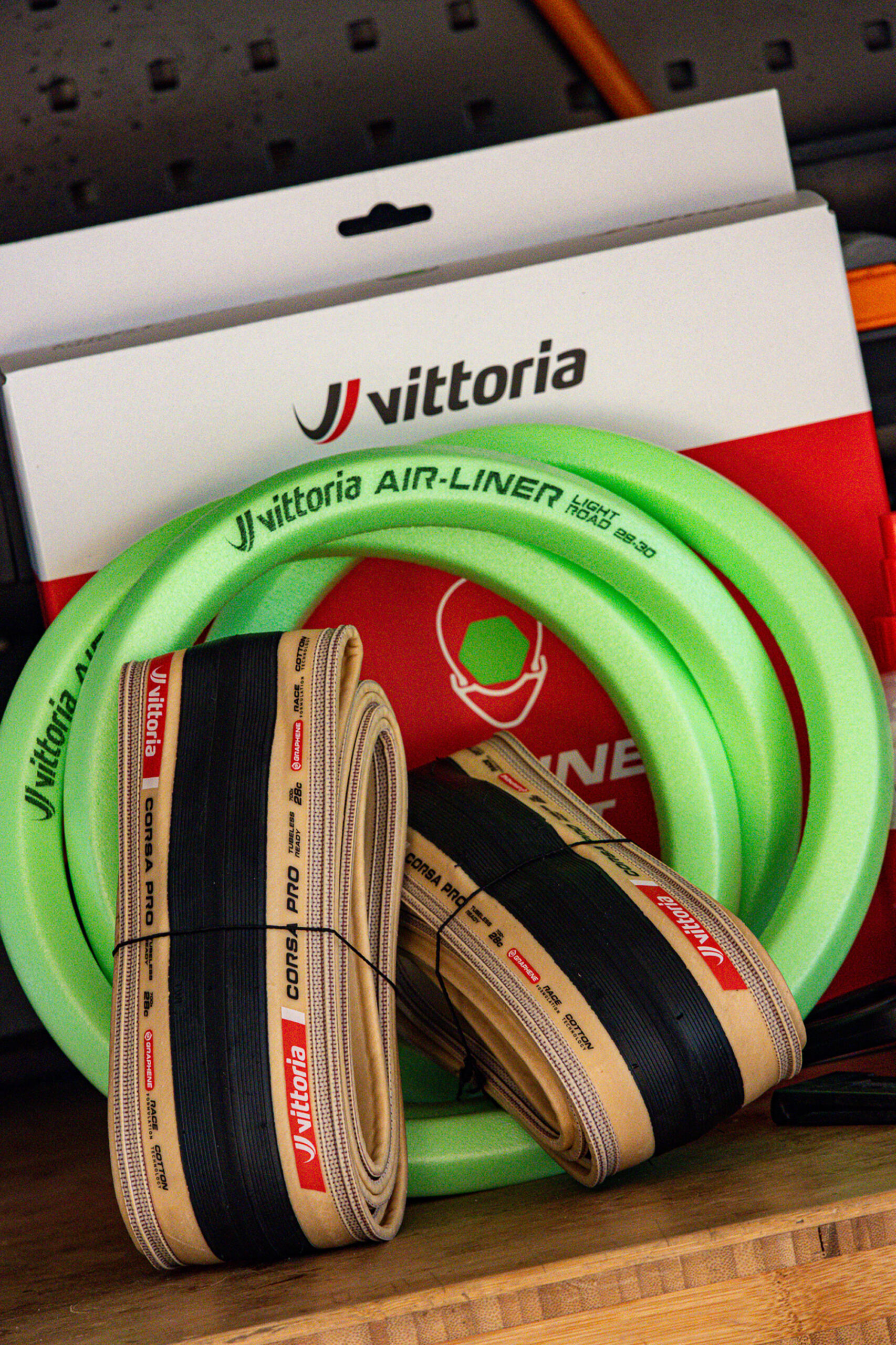
Vittoria-Air Liner Light-Road bike run flat tire insert with packaging.

But first, here’s why you should care about these inserts at all: It uses a semi-closed cell foam that works by slowly absorbing the air pressure in fully inflated tires. Then, when you puncture, the rapid release of air from your tire causes them to swell up and fill the tire, keeping you riding on air…almost like normal.

We’ve tested them on the trails, and the tech works. But there’s more to it. Not only does it work to keep you rolling when you flat, it changes the ride quality for the better.
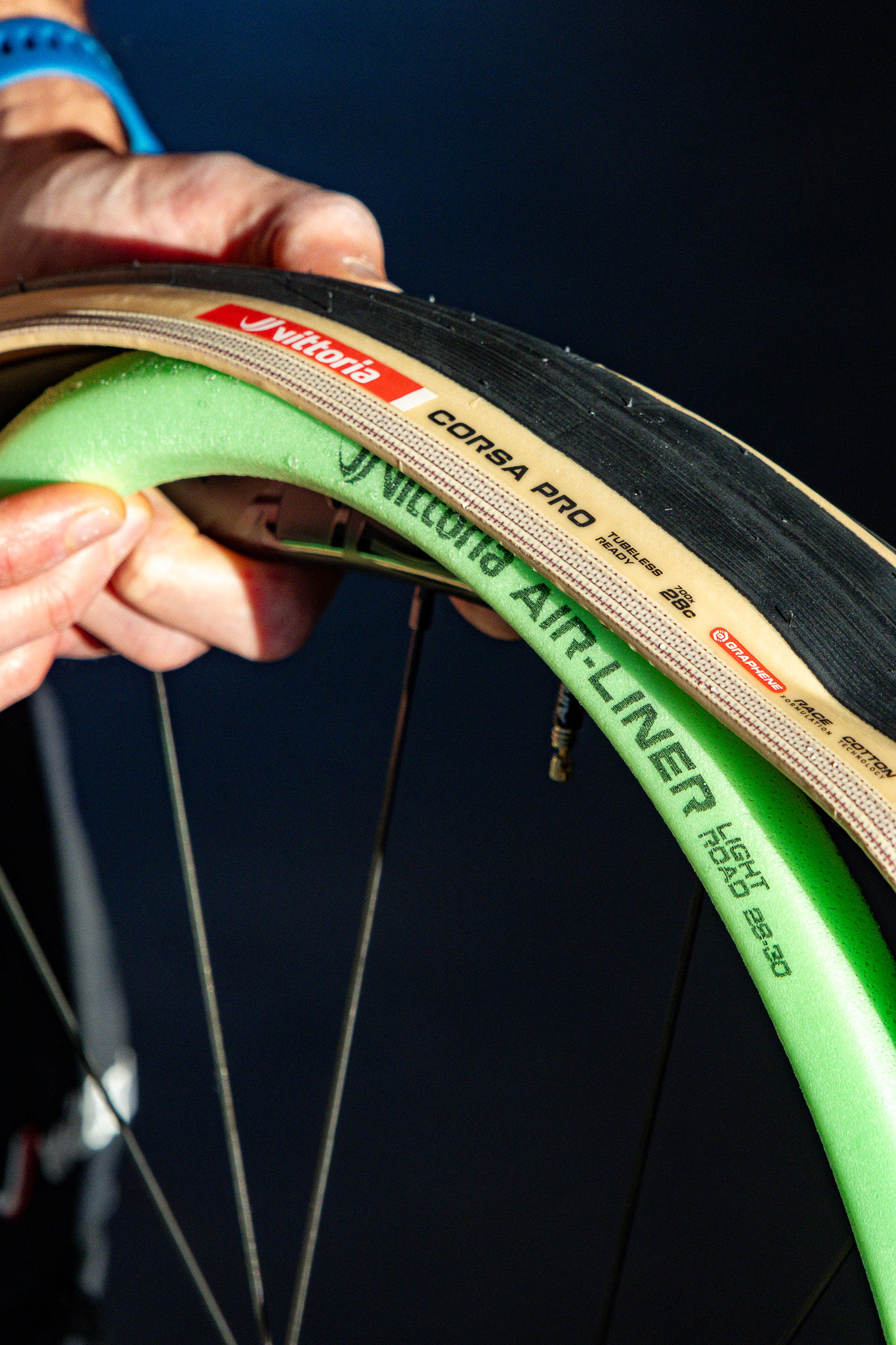
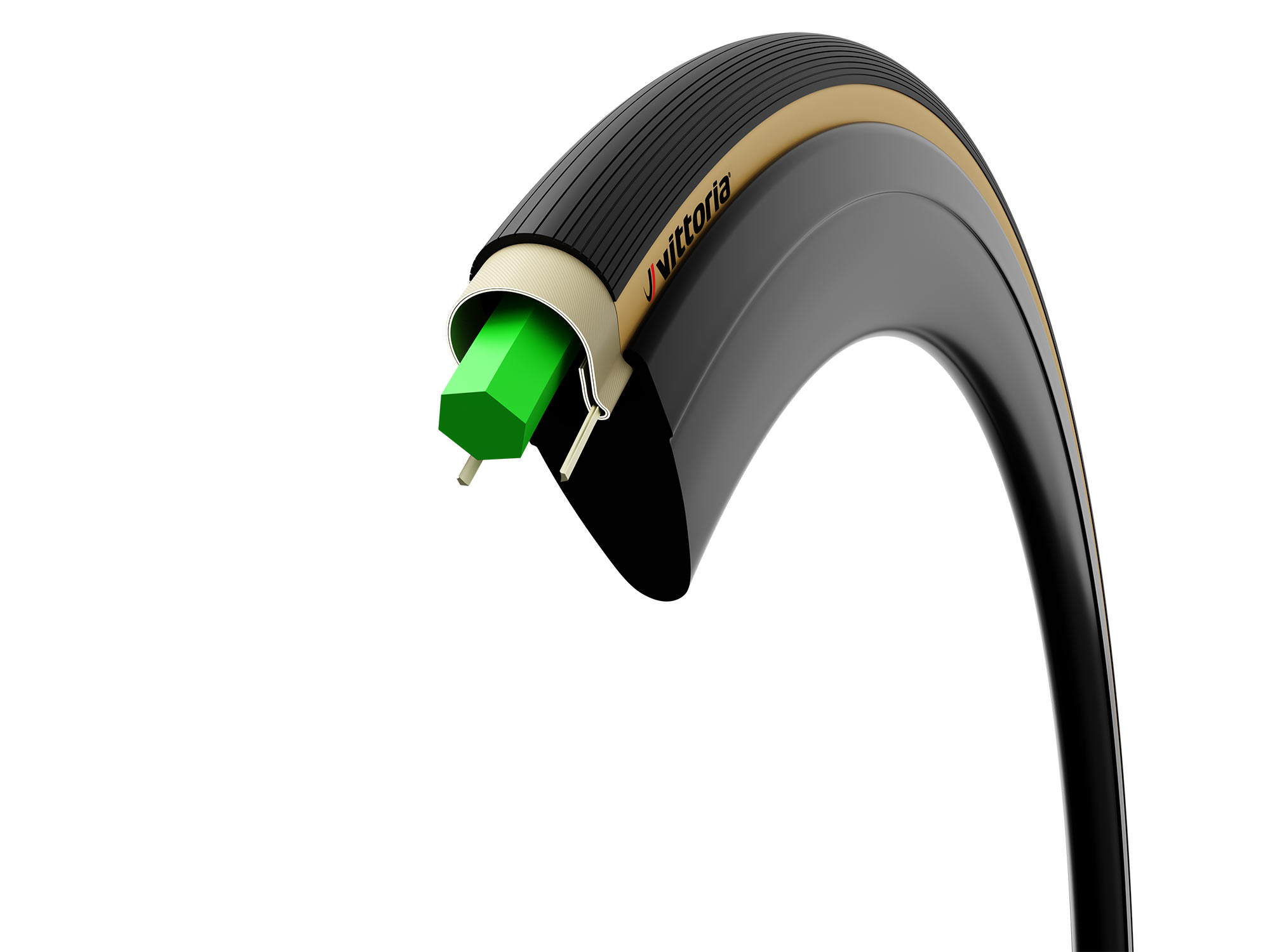
The Air-Liner Light inserts let you run slightly lower pressure for better traction and a smoother ride. This works because there’s a foam insert to mitigate the hits and provide support in the corners.

Now, the new Air-Liner Light Road uses a better material and extrusion process, making it easier to slide into the tire during installation. That material’s surface is also less likely to hold sealant, meaning you can use slightly less (they still recommend at least 10ml per tire).

EF pro cyclists riding with Vittoria-Air Liner Light-Road bike run flat tire insert in their tires.
All photos courtesy of Vittoria.

Combined, the sealant plus insert lets you ride up to 50km (~30 miles) after a puncture. The insert gradually releases its air, so you won’t get that dangerous blowout, and even when it’s “flat”, it’s still equivalent to roughly 1 bar (14.5psi) of air pressure. It’s enough to get you home…or across the finish line.

They add just 30-40g per tire (depending on size), which isn’t enough to stop EF-Education First riders from using it. MSRP is $77.99 per wheel.

Vittoria.com

Subscribe
Notify of
guest

This site uses Akismet to reduce spam. Learn how your comment data is processed.

14 Comments
Oldest
Newest Most Voted
Inline Feedbacks
View all comments
Gareth
Gareth
1 month ago

Is there a watt penalty that comes with using these? Does it increase working resistance?

Greg
Greg
1 month ago
Reply to  Gareth

At least for the prior version, no. Under pressure, the foam collapses to be small and basically not interacting with the relevant parts of the tire

TheKaiser
TheKaiser
1 month ago
Reply to  Greg

Initially when pressurized it’ll collapse and compress, but as it absorbs air and eventually reaches equilibrium with the air in the casing it’ll grow back to it’s original size, no?

Robin
Robin
1 month ago
Reply to  TheKaiser

No, it won’t. Tire inserts are typically made from closed cell foams, and that means there’s effectively nowhere for the air to go inside the inserts. These inserts are made so they don’t soak up sealant, and that means they also don’t absorb air.

TheKaiser
TheKaiser
1 month ago
Reply to  Robin

Did you actually read the article or skip right to the comments? If you read the article above it specifically says these inserts are different from most others: “But first, here’s why you should care about these inserts at all: It uses a semi-closed cell foam that works by slowly absorbing the air pressure in fully inflated tires. Then, when you puncture, the rapid release of air from your tire causes them to swell up and fill the tire, keeping you riding on air…almost like normal.”

TheKaiser
TheKaiser
1 month ago
Reply to  Robin

Yes, it will. While tire inserts may “typically” be made from closed cell foam, you seem to have missed the part of the above article that specifically says…But first, here’s why you should care about these inserts at all: It uses a semi-closed cell foam that works by slowly absorbing the air pressure in fully inflated tires. Then, when you puncture, the rapid release of air from your tire causes them to swell up and fill the tire, keeping you riding on air…almost like normal.” To me, that reads as the insert takes on additional air until some sort of balance is reached. Then, when a puncture releases the air from the casing, the insert enlarges to a size greater than its starting volume, due to the additional air it has taken on.

Vinny
Vinny
1 month ago

***doesn’t work as claimed on cobbles! See Giant/Cadex wheel explosion/debacle from this past weekend. WHAT A SHAM. be safe out there***

Mr Pink
Mr Pink
1 month ago
Reply to  Vinny

Worth noting that cobbles and pro level power output kept carbon wheels out of such races for years while enthusiasts enjoyed them trouble free. They also often switched to aluminum bars instead of carbon too. On goes the list.

No one commenting on this post will have an issue.
No one.

FritzP
FritzP
1 month ago
Reply to  Vinny

From what I’ve read the rider continued riding on a flat rear tire for quite a while, hammering the wheel on cobbles. The wheel was built using carbon spokes and non-captive slotted hubs. The hub ends of the spokes popped out of the slots which can be seen as all the nipples on the hub ends of the spokes are still there. Riding fast on cobbles with decreased pressure on a foam insert in the rear wheel is probably a bit outside ‘normal’ circumstances for these inserts. The expansion of the insert with loss of tire pressure doesn’t last forever. He probably got further with the insert than if he hadn’t had the insert. The wheels failed because of a bad hub design and being used waaaay outside normal use case.

Last edited 1 month ago by FritzP
Robin
Robin
1 month ago
Reply to  Vinny

Cars don’t work because they’re unable to go up 173% grades. Hammers don’t work because they sometimes bend the nail. Baby carriages don’t work because they tumble end over end when allowed to roll down stairs by themselves.

How many people ride that particular tire and insert combo at pro speeds over cobbles after flatting? I’m guessing no one. The use case matters.

Matt
Matt
1 month ago

Why does a piece of foam cost $80?

Dinger
Dinger
1 month ago
Reply to  Matt

Because a company created tooling, packaging and marketing for a very low volume specialty item to sell.

Veso Mandaric
1 month ago
Reply to  Dinger

hahahahahahahahaha 🙂

Christopher
Christopher
28 days ago

Why not just use a tube?

Subscribe Now

Sign up to receive BikeRumor content direct to your inbox.