

After riding high as the undisputed leader of wireless dropper posts for almost six years, RockShox got a wakeup call when Fox finally launched the Transfer Neo in the late summer of 2024. With a shorter stack height and collar-mounted electronics, the Fox Neo bested the Reverb’s maximum drop of 170mm with a 200mm option — now up to 225mm after today’s announcement. Add to that Fox’s own lightning-fast Neo wireless protocol and a wireless remote with familiar ergonomics, and the Reverb was no longer the best wireless dropper on the market.
It had surely been in the works for some time, as it didn’t take long for RockShox to respond with an updated Reverb AXS. Known more formally as the Reverb AXS B1, the 2nd generation of the flagship wireless dropper launched in April of 2025. The new version addresses the shortcomings (literally) of its predecessor with more and longer sizes, new internals, and a new, collar-mounted position for the battery and controller. Overnight, the Reverb AXS went from being “too short” to the longest dropper on the market, along with improved fitment and aesthetics.
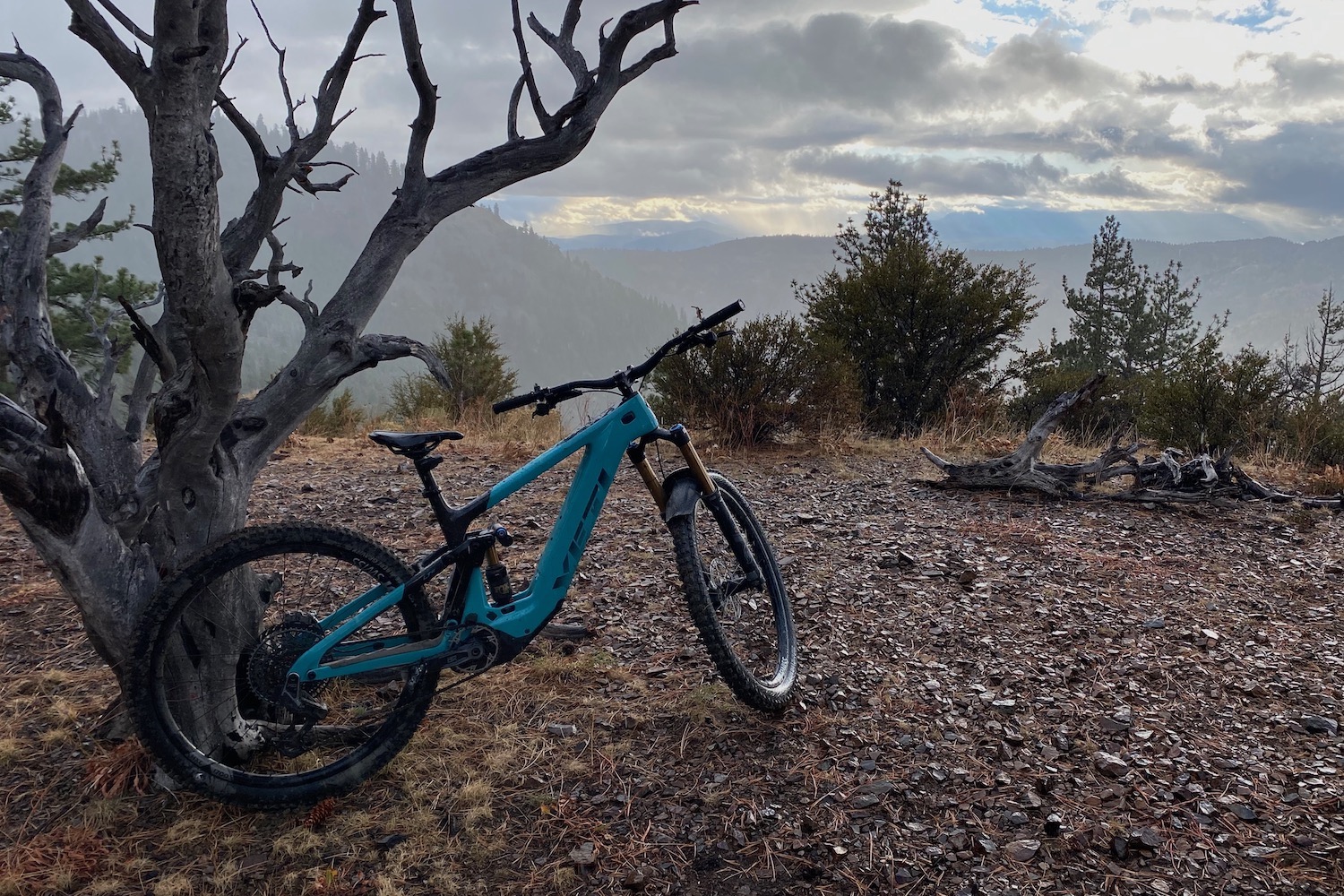
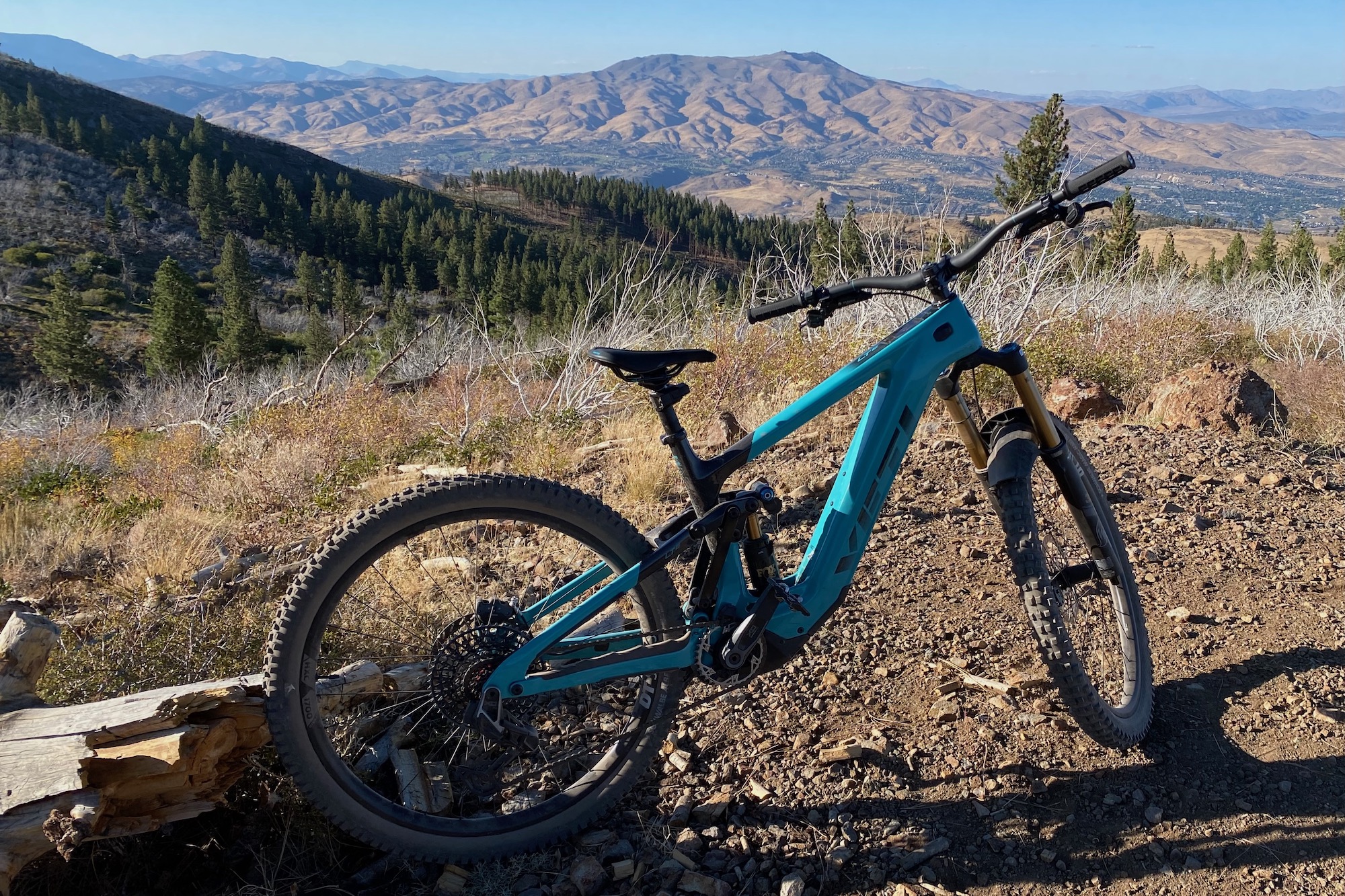
The Yeti LTe e-bike that I’ve been riding on and off since September came with the latest Reverb AXS dropper. I’ve been testing it on that bike for months and have spent enough time riding it to know that it’s a big improvement over the original. It’s also the longest dropper on the market with unmatched wireless system integration, but does that make it the best? I think it depends…

- MSRP: $599 (remote sold separately)
- Available Travel Lengths: 100, 125, 150, 175, 200, 225, 250mm
- Overall Length: 546mm (200mm drop)
- Available Diameters: 30.9, 31.6, 34.9mm
- Size Tested: 31.6 x 200mm
- Measured Weight: Post: 733g, Remote: 50g (incl. matchmaker clamp)
Pros
- Lower stack than previous version
- Better tire clearance than previous version
- Super easy post installation
- Available in drop lengths greater than 200mm
- More affordable (but still expensive)
- Part of the AXS ecosystem of components
Cons
- Expensive – but cheaper than previous
- Higher stack and heavier weight compared to cable actuated posts
- Need to remember to charge battery
- Controller sold separately
RockShox Reverb AXS Details
Cory covered the latest Reverb AXS in detail when it launched last April. If you missed that article, it’s worth revisiting to get the full rundown on the changes that RockShox made. I’ll cover the most important updates again here, but I’ll try and keep it short.
The original Reverb AXS maxed out at 170mm of travel. In the ongoing longest dropper competition, it was surpassed by nearly every cable-actuated dropper on the market, as well as the wireless Fox Transfer Neo’s 200mm length (now up to 225mm). The new version flipped that script to become the longest dropper on the market, with a 250mm option. It is now available in seven travel lengths, ranging from 100mm to 250mm in 25mm increments.
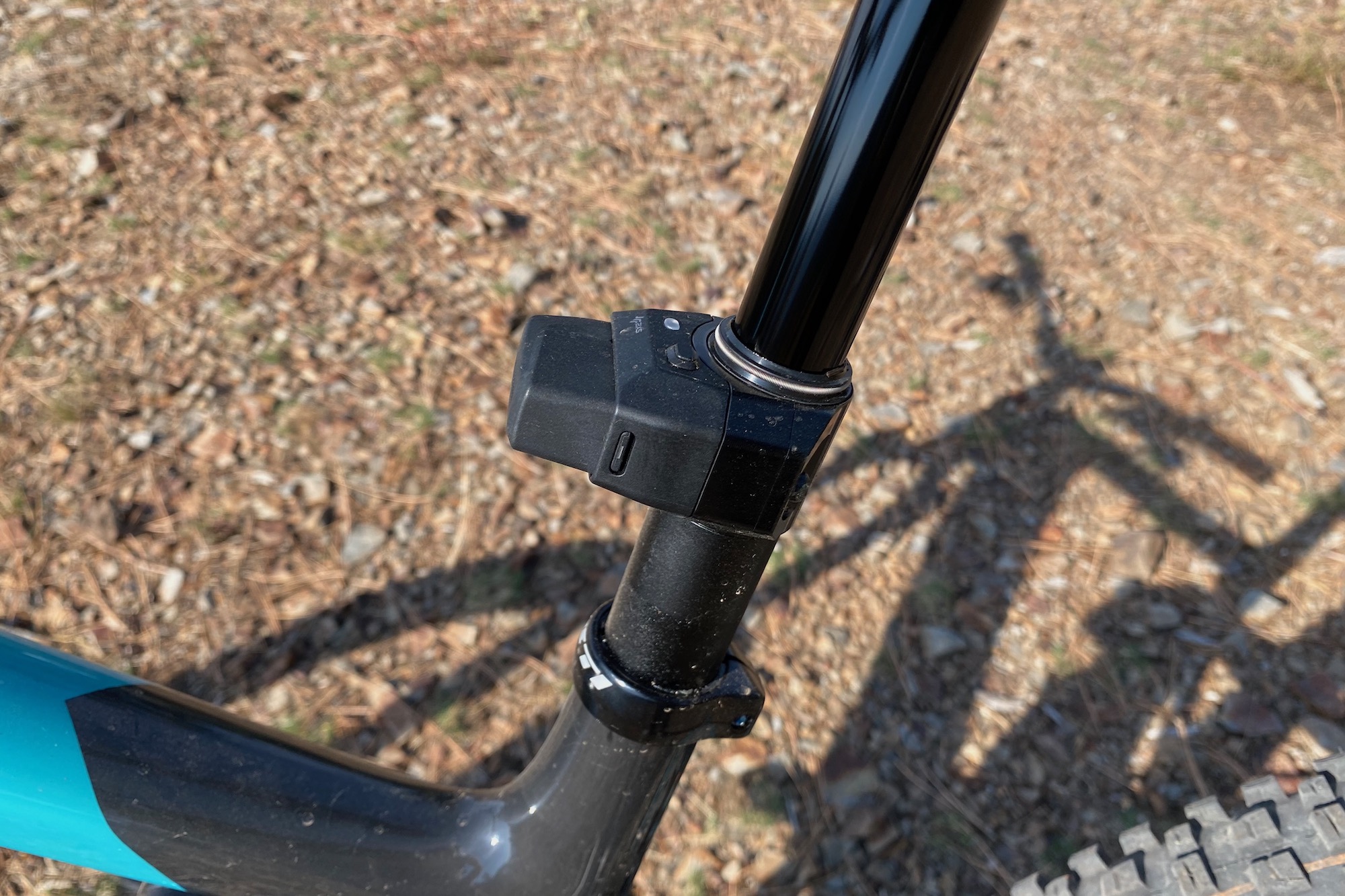
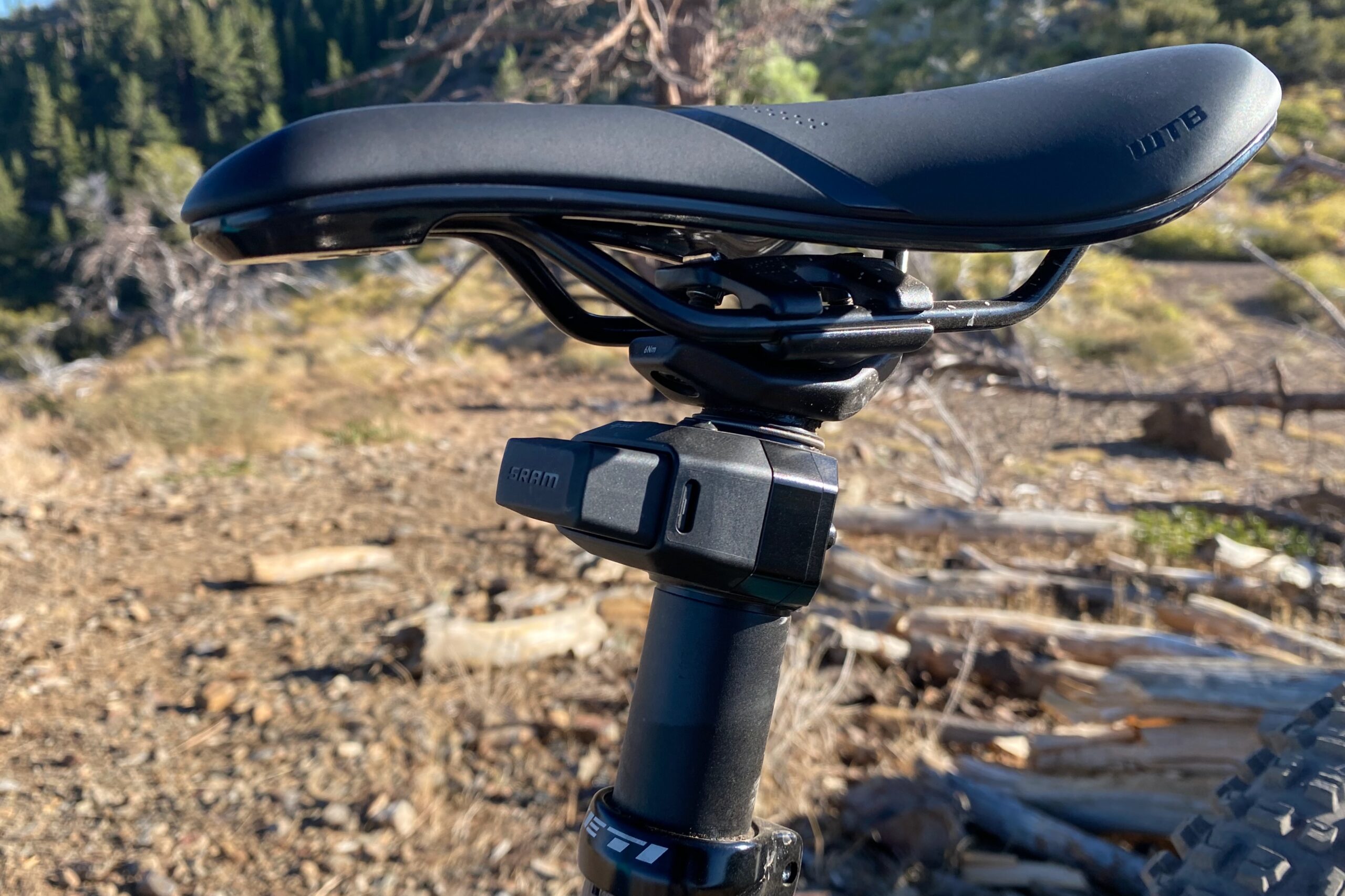
RockShox moved the battery and controller from the top of the post to the collar. Preferences vary, but I believe the collar location is more aesthetically pleasing. This also helps to eliminate the chances of tire clearance issues while making it possible to use a more traditional two-bolt saddle clamp. Interestingly, this change didn’t do much to reduce stack height, which at 62mm is still quite tall. For comparison, the Fox Neo is 47mm, and the cable-actuated OneUp V3 is 30mm.
That said, RockShox did manage to reduce the length of the lower tube and maximum insertion. It measures 284mm on my 200mm travel post, which is a fair bit shorter than the 315mm of my comparably sized Fox Transfer Neo. So, while the stack height may still be tall, insertion has been improved, which may make it easier to fit on some frames.

Internally, the new air-over-air system is meant to be more robust and easier to service. It also makes it possible to pick up a bike by the saddle with the dropper compressed without fear of impacting its function. This allowed them to get rid of the Vent Valve as it is no longer needed (part of the insertion length reduction). RockShox also gave the new Reverb AXS a little ActiveRide compliance that allows the post to move slightly under the rider in any position other than fully topped or bottomed out.
Living With the Reverb AXS

I’ve ridden with the original Reverb AXS extensively over the years, and most recently on the Yeti ASR XC bike that I tested in 2024. In my opinion, it always worked well enough, but the extra weight and limited sizing never made it something I wanted to buy. I think wireless components are cool, but in the case of dropper posts, the cable-actuated options have been and continue to be lighter and have faster actuation than the Reverb AXS. Prior to the new version, cable-actuated posts offered more and longer travel options, too.
The new Reverb addresses what was arguably the biggest issue with the original, with the addition of 200, 225, and 250mm travel lengths. Now, lanky people like me can get the most drop possible. The Yeti LTe I’m testing came with a 200mm, but I’m sure I could easily fit a 225mm on there if this bike were mine. All of the measurements are oddly difficult to find, but the travel calculator on the website works pretty well.

Speaking of that, the reduced length of the lower tube/maximum insertion is notable here as well. RockShox did away with the Vent Valve (23mm) on the bottom of the post, although there is still a shorter plastic cap (10mm) on the new one. The old version, in a 170mm length, had a maximum insertion of 268mm, while the new version, in a 175mm length, has a maximum insertion of 260mm. More travel with less length = the potential to squeeze a longer travel post on a frame. That’s a win for many riders.
While the stack height of 62mm is only a few millimeters shorter than the original, the collar-mounted position of the battery and controller is an upgrade, in my opinion. At my height, I was never at risk of tire clearance issues, but I appreciate that the electronics are out of the direct line of fire of tire spray. The traditional 2-bolt saddle clamp is also a step up from the funky, and sometimes noisy, single-bolt clamp on the previous version.

I also prefer the aesthetics compared to the previous version. I’m kinda splitting hairs here, but I also prefer the shape of the parts, compared to the squared-off, blocky look of the battery on the Fox Transfer Neo. Still, like most people, I thought the new Reverb looked a little odd at first, but now I don’t even notice it. The same goes for the Fox post; it just seems normal to me now.
Functionally, the Reverb AXS has worked perfectly for me the entire time that I’ve been using it. With the new air-over-air internals, it hasn’t developed any sag, and you can actually pick up the bike by a dropped saddle and not cause any issues. I know ActiveRide is there, but I don’t notice it all while riding, which I suppose is a good thing. I haven’t touched the air pressure since it reportedly comes set at 600 psi, but the speed of compression and extension has been working very well for me, and I see no need to mess with it. It goes up, it goes down, and it has been working reliably for months. That’s not something I can say about any of the previous Reverbs I’ve used.
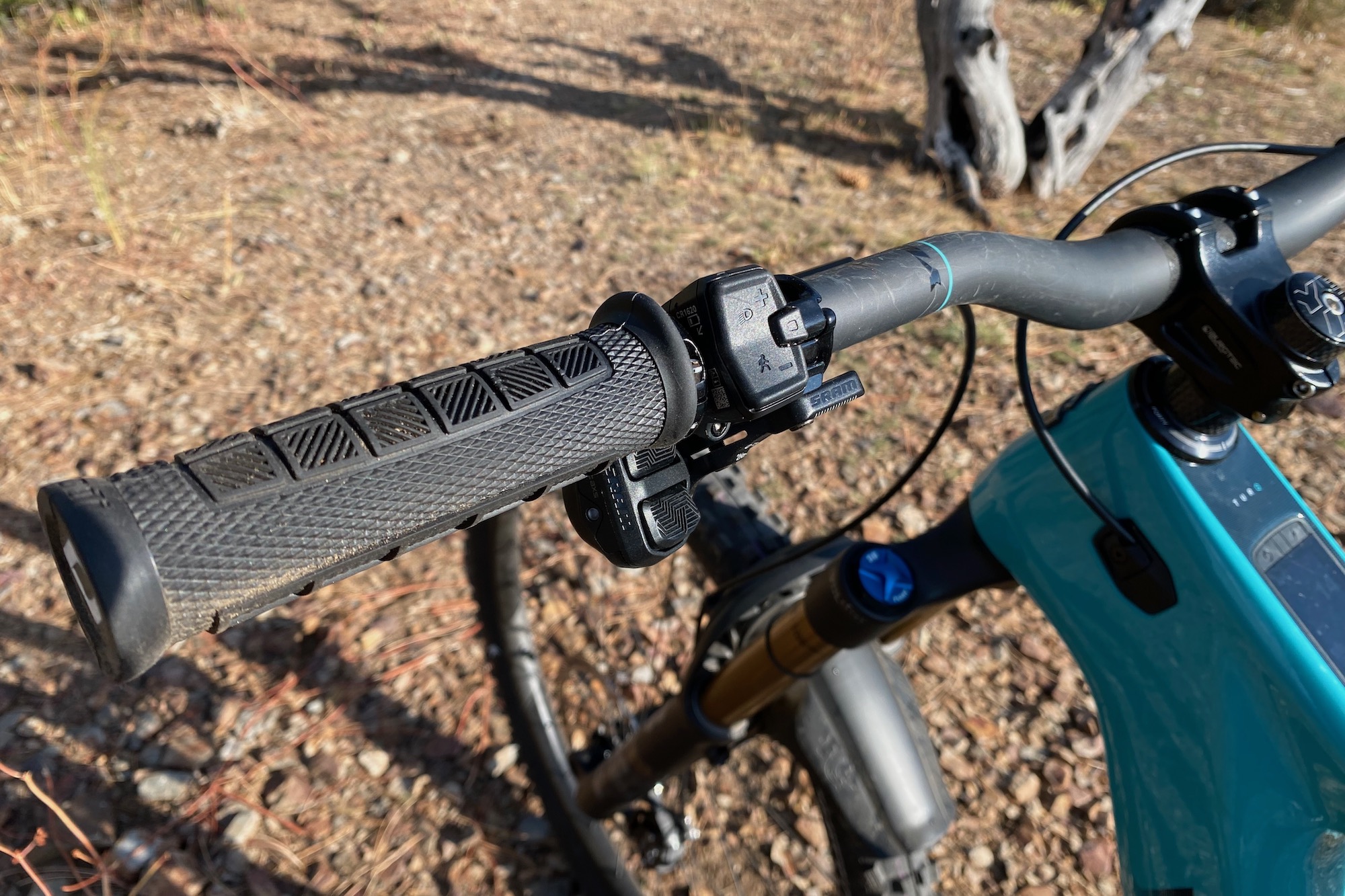
The AXS wireless actuation works the same as it ever has, which is to say, it’s fine but not amazing. In fact, I’d argue that’s the least impressive aspect of the Reverb AXS’s performance. It’s not that it’s slow exactly, but the actuation speed is noticeably slower than Fox’s lightning-fast Neo wireless protocol. I’m also a huge fan of the ergonomics of the Fox wireless remote. To me, the difference is quite dramatic, and the primary reason I think the Transfer Neo is currently the best wireless dropper on the market.
But, and this is a VERY BIG BUT, SRAM’s full AXS ecosystem of components is hard to overlook. I’ve expressed my dislike of the Pod Controllers before, and that still stands, but being able to integrate all of your AXS components together is impressive and not something you can do with Fox and/or Shimano (although it would be cool if they teamed up for something like that). The ability to customize all of your controls is also nice, especially if you’re running a Transmission drivetrain, Flight Attendant suspension, and an AXS dropper together, like I was on that Yeti ASR.
The 1-year/300 hours/10,000 actuation Basic Service interval is also quite long, and the Complete Service is double that. I’m nowhere close to needing service, so I haven’t taken mine apart. Based on the service manual, the service procedures appear to be something that confident, experienced, and/or adventurous mechanics could potentially do themselves. I’ll still probably take mine to the professionals.
I was also happy to see that RockShox was able to lower the price to $599. That price does not include a remote, however, which will cost you $165 ($220 for the Ultimate Pod) if you don’t already have one. The $764 total price is still quite high, obviously, but less than the $861 for the previous version or $859 for the Fox Transfer Neo.
What’s Not to Like?
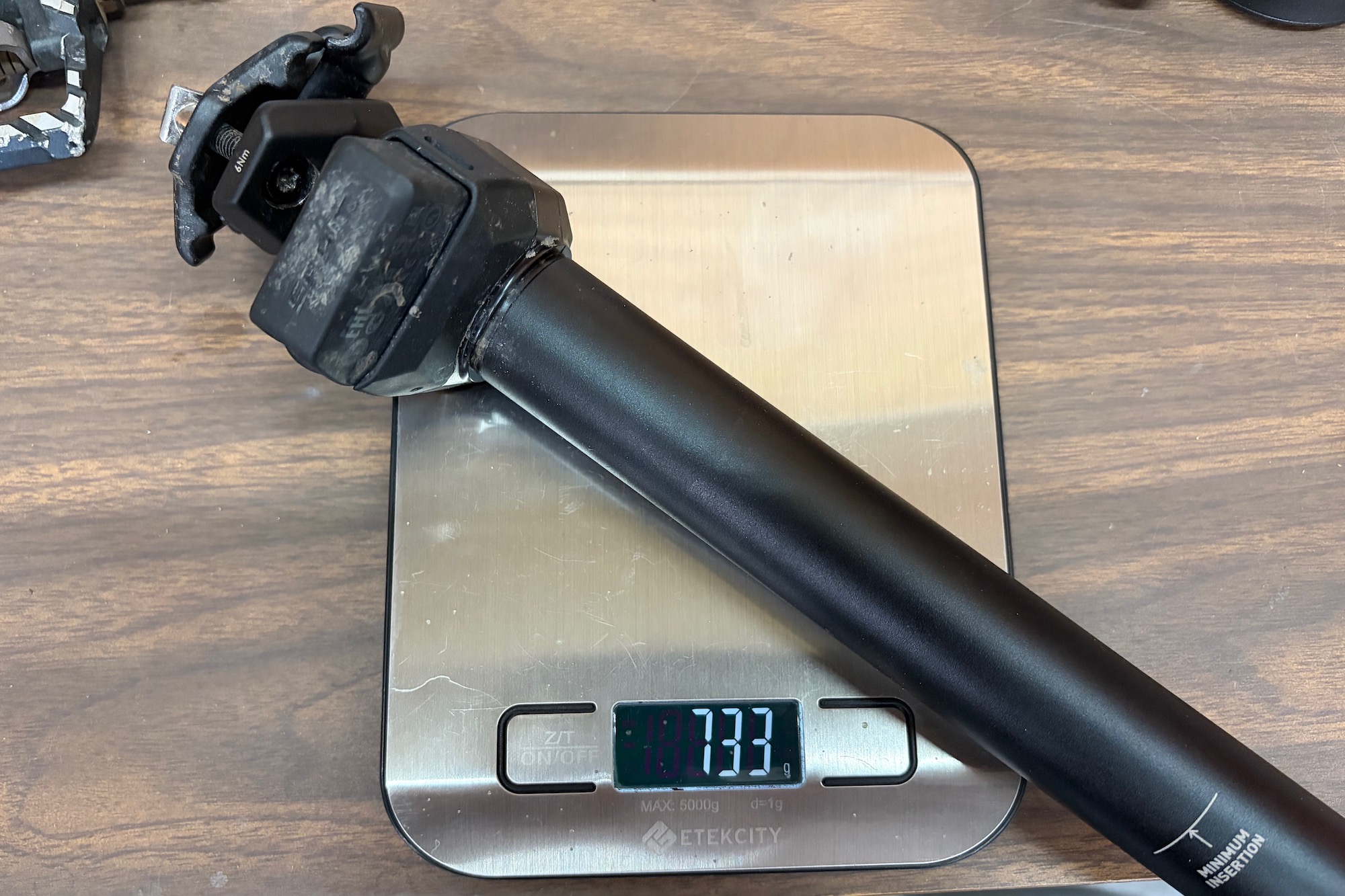
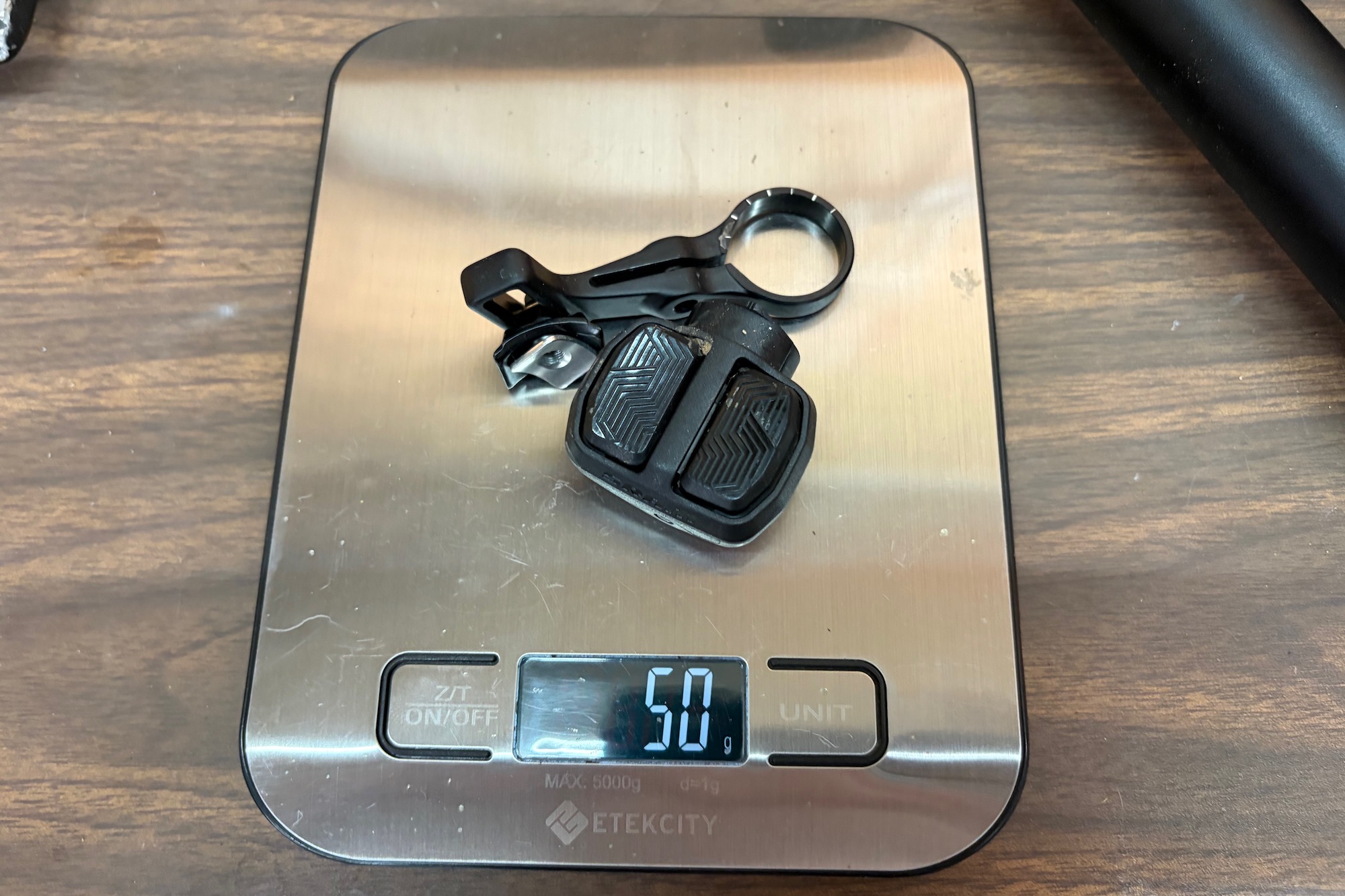
While RockShox has addressed some of the complaints about the original, the new Reverb still suffers from the issues inherent with wireless droppers. Weight is one of the most obvious drawbacks, and the 31.6 x 200mm post I have weighs 733 grams (post and battery). The Pod and Matchmaker clamp weigh another 50 grams, bringing the total up to 783 grams. For comparison, that’s 34 grams heavier than the Fox Transfer Neo in the same size, and 150 to 200 grams more than most comparable cable-actuated posts.
And let’s not forget about batteries. Yes, the AXS battery lasts a surprisingly long time, but you’ve got to remember to charge it every once in a while. A proactive approach works well here, but most people will inevitably experience a dead battery at the trailhead or mid-ride eventually. But if you have other AXS components, the shared battery and charger are kinda nice from a convenience standpoint.
Despite claims of “up to a year” lifespans for the remote batteries, my experience is quite different. I usually don’t have a test bike for more than a couple of months, and I’ve probably replaced 10 coin cell batteries in Pods, including for this dropper. It has happened enough times that I carry an extra CR2032 in my pack all the time.
RockShox Reverb AXS: My Takeaway
The battle for the best wireless dropper post is going strong, and RockShox came out swinging with the 2nd generation of the Reverb AXS. Personally, I’m a little torn between it and the Fox Transfer Neo, as they both have aspects of their design and performance that set them apart.
The Fox post is incredibly smooth, consistent, and has a shorter stack height and slightly lower weight. I greatly prefer the ergonomics and familiar shape of the remote, and I’ve been very impressed by the speed of Fox’s Neo wireless protocol. It’s truly on another level. Today’s addition of a 225mm length narrows the gap significantly, as well.
At the same time, the addition of more, longer travel lengths gives the Reverb the title of the longest dropper on the market and makes it arguably the best option for the tallest riders. Fitment is improved slightly with shorter insertion depths, and the updated battery position allows for a regular saddle clamp, and it looks better, in my opinion. The integration with other AXS components is slick and sure to please those on board the SRAM AXS train.
I’m not trying to say that wireless droppers aren’t an unnecessary extravagance, but if you’re shopping for one, I don’t think you can go wrong with either. I’m partial to the Fox Neo, but the very tallest riders and those running other AXS components will likely gravitate toward the Reverb, and that’s a logical choice. Especially so now that it has improved, more reliable internals, and comes in a length to suit every rider.


