


These days, it seems like it’s becoming increasingly common for brands to launch new helmets along with news of their chart-topping Virginia Tech Ratings. And that’s exactly what PIKIO (pronounced P Q) LABS is doing with its new Si road cycling helmet, featuring the brand’s OBLIK impact management technology. But unlike most new helmets, which have improved scores incrementally, PIKIO LABS has essentially dropped the floor out from under the competition.
With Virginia Tech’s test lab becoming the de facto source for comparative impact testing, it seems to have sparked some competition among helmet brands. In recent years, we’ve seen the scores in Virginia Tech’s ratings creep lower and lower, with a lower score equating to better performance in its standardized impact testing. Because helmets have been scoring so much better and, presumably, been getting safer, Virginia Tech even recalibrated its star-rating scale last year to account for it.
And with new helmet models and impact-management technologies hitting the market, the scores keep going down, but the margins have typically been by fractions. Which is why the new PIKIO LABS Si helmet’s score is so impressive. With a score of 4.61, the Si helmet is 2.21 points lower than the #2 rated helmet, the Canyon Deflectr RLS at 6.82. That’s not an incremental step forward, that’s a leap. So, who is PIKIO LABS, and what’s up with this new Si road helmet and its OBLIK technology?

PIKIO LABS
According to the press release, “PIKIO LABS Inc. is a Canada-based company advancing helmet technology through research-driven engineering, biomimicry, and structural optimization.” The company founder and CEO, Dr. Daniel Abram, has a PhD in Design Optimization and “has spent more than 17 years developing head protection technologies,” including the brand’s OBLIK impact management technology.
This is the first we’ve ever heard of PIKIO LABS, and it appears that the Si road helmet is the brand’s first and only commercial product. On the PIKIO website, however, they state that the Si helmet is the result of “years of structural research, test and refinement.” Let’s see what it’s all about.

PIKIO Si Helmet
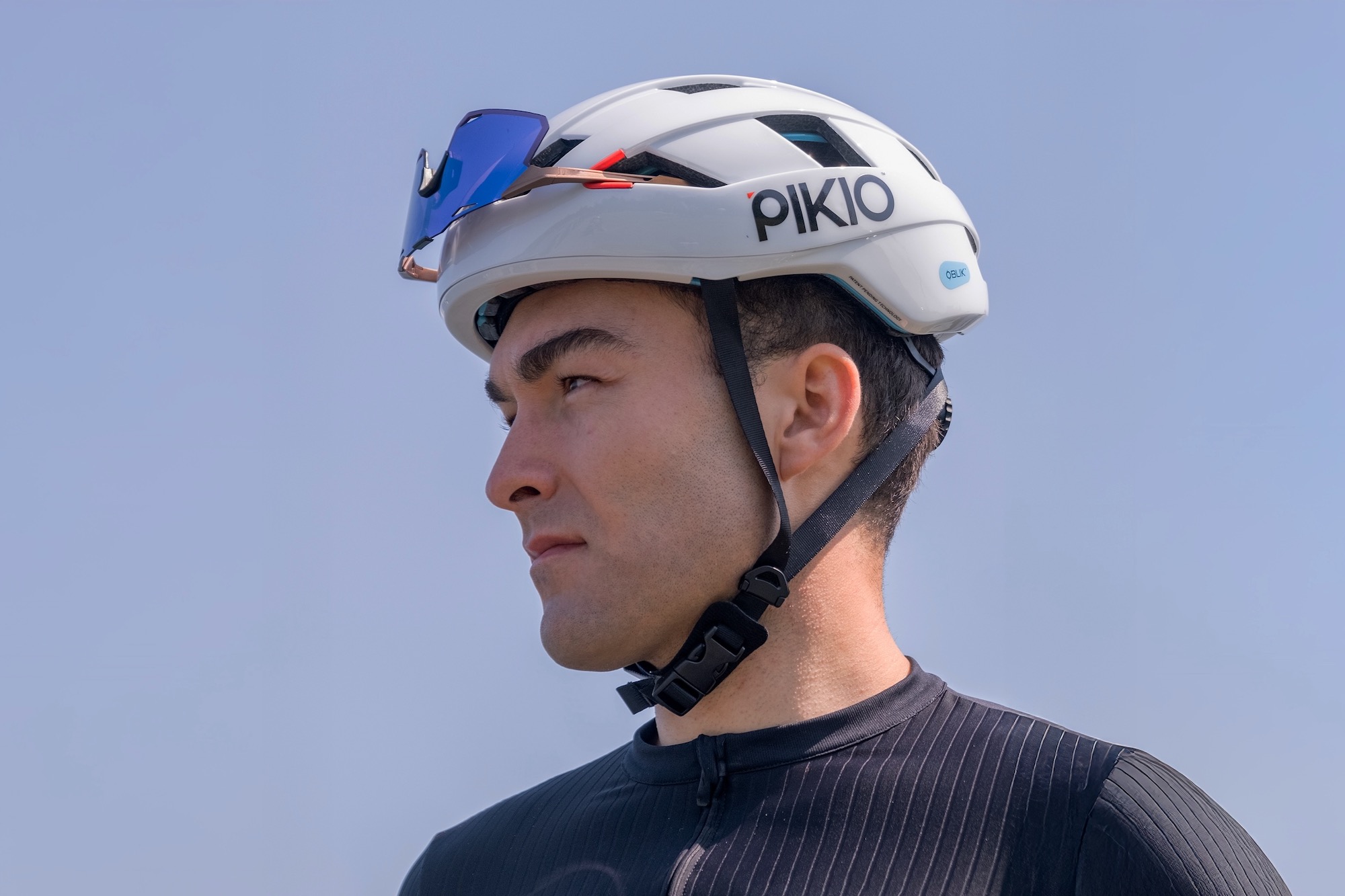
On the surface, the new PIKIO LABS Si helmet just looks like a standard helmet. It doesn’t have the most exciting appearance. In fact, it kinda looks a little bland. But according to PIKIO, that’s a deliberate choice to reduce the chances of the helmet’s outer shell catching on surfaces during a crash. Along with its appearance, the brand states that the helmet is engineered to combine its OBLIK impact management, ventilation, comfort features, and structure as a unified system.
OBLIK
The brand’s OBLIK impact management system is the biggest story here. It operates on the same principle popularized by MIPS, reducing rotational forces transmitted to the brain during oblique impacts, but with a unique approach that appears effective, given its impressive Virginia Tech score.
“Conventional helmets generally rely on a single foam liner designed to crush under load. Some designs incorporate a low-friction slip layer intended to help reduce rotational forces. While these approaches are effective to a degree, they are inherently constrained by the internal geometry of the helmet, which can limit how linear and rotational forces are managed during oblique impacts. We developed OBLIK to allow the helmet structure itself to respond more adaptively to oblique impacts.”
-Dr. Daniel Abram, founder of PIKIO LABS
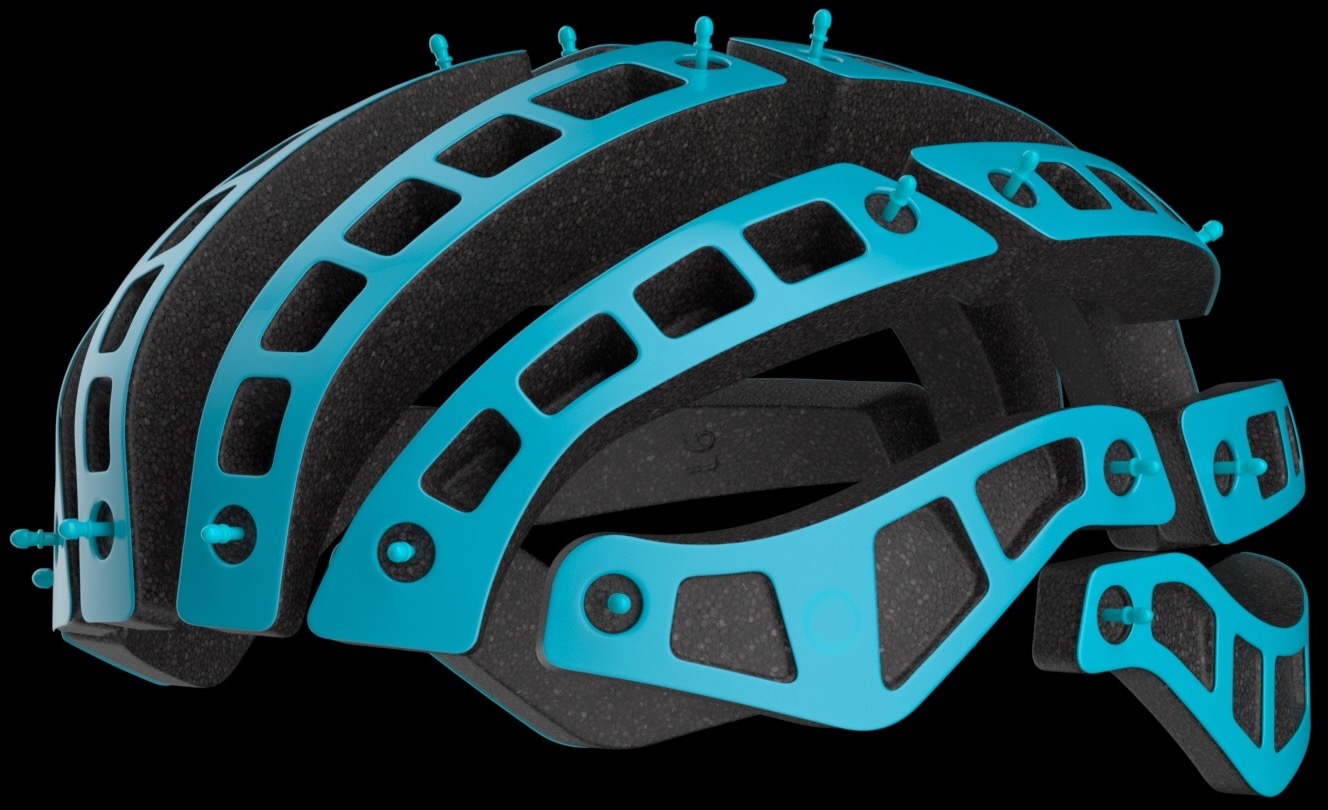
How is OBLIK different? Well, the brand tells us that “Rather than relying on a single foam liner, OBLIK divides the helmet’s shock-absorbing liner into a base liner and independently moving modules connected through a deflection-sensitive nodal system. During impact, individual modules can move based on impact intensity, location, and direction, helping reduce linear and rotational forces.” We’ve seen numerous dual-shell designs before, but what stands out about OBLIK to us is that each piece of inner liner appears to be separate, allowing them to move independently and more locally as they respond to the forces of an impact.
PIKIO’s founder, Daniel Abram, tells us that the large jump in the impact testing score has to do with the fact that the OBLIK system has eliminated some of the constraints of more traditional designs. He says, “Rather than compressing material in one direction, the system is able to deform, redirect, and dissipate energy across multiple pathways. This becomes particularly important in oblique impacts, where linear and rotational forces occur simultaneously.”
Additionally, the brand states that the dual-layer, dual-density structure uses “macro-cavities.” If you’re wondering what a macro-cavity is, it is described as being inspired by bone structure and is an engineered void integrated into the liner structure that helps to absorb impact while reducing material and weight.

PIKIO Si Design Features
- Modular Impact Architecture: Discrete modules are individually attached to a base liner.
- Deflection-Sensitive Nodal System: Nodal interfaces allow modules to move independently based on the intensity, location, and direction of the impact force.
- Biomimicry-Based Macro Cavities: Bone-inspired internal macro-cavities in the foam enhance energy absorption through deformation and compression.
- Dual-Density Foams: Optimized foam densities for both low- and high-energy impacts.
- Reinforced Layers: Polycarbonate reinforcement integrated into the modules to increase structural strength while maintaining low weight.
- Aerodynamic and Ventilated: Aero performance and airflow comparable to leading premium road helmets. Wind tunnel testing was conducted at the University of British Columbia’s Aerolab.
- Integrated Eyewear Dock: Built-in eyewear dock allows convenient storage of sunglasses when not in use.
Aerodynamics and Ventilation
PIKIO claims that “OBLIK improves ventilation through continuous deep airflow channels, larger strategically placed true-vents, and reduced internal material blockage.” Additionally, PIKIO says that wind tunnel testing at the University of British Columbia’s Aerolab confirmed aerodynamic performance “comparable to leading premium road helmets.”

Weight
PIKIO states that OBLIK technology improves safety without adding extra weight. With claimed weights of 255g (S), 279g (M), and 298g (L), the Si helmet is not exactly in the running for the lightweight crown, but it’s certainly not what we’d call “heavy,” either.

Certifications
In addition to the Si helmet’s chart-topping Virginia Tech score and 5-star rating, it is also certified to the U.S. CPSC Bicycle Helmet Standard.

Sizing and Color Options
The PIKIO Si helmet is currently available in four colors: Titanium Gray, White Pearl, Black Onyx, and Graphite Black. It comes in three sizes: Small (51-55cm), Medium (55-59cm), and Large (59-61cm).

PIKIO Si Helmet: Pricing and Availability
The new PIKIO Si helmet is available now in the U.S. and Canada on the PIKIO LABS website. It retails for $379 USD, and the brand states that Canadian customers will see pricing in CAD at checkout. Head to the brand’s website to learn more about PIKIO LABS, the Si helmet, and OBLIK technology.
And with the lab-proven effectiveness of the OBLIK technology, it’s safe to assume we’ll see it integrated into helmets for other sports and potentially licensed by other brands. We won’t be surprised if we see more OBLIK-equipped helmets in the not-too-distant future.
