During Crankworx Whistler this summer, I picked up a pair of Maxxis’ updated Dissector tires for testing. Typically, I would ride more aggressive treads like Maxxis’ Assegais/Minions, so I was curious to see how the lesser-lugged Dissectors would handle my area’s steep and technical terrain.
The new Dissectors are designed to excel in dry, hardpack conditions, but due to their launch timing, I did my testing throughout the fall. Consequently, I wound up riding these tires on everything from fairly dry dirt to slick wet roots and rocks. I am pretty impressed with the Dissectors – They’re an ideal option for those who want a faster rolling MTB tire without sacrificing much in terms of traction.
Maxxis Dissectors – Construction Features:

For complete details on the second-generation Dissector tires, check out our launch article from earlier this summer. Maxxis didn’t change the Dissectors’ intentions with this update; they simply sought to make some improvements. The tread design was redesigned to offer better traction while cornering and braking, without giving up their rolling speed.
Categorized as a trail/enduro tire, the Dissector’s tread is not front or rear-specific, so it can be run in either position (or both, as I did for testing). Maxxis suggests pairing a Dissector front with a faster-rolling rear for shorter travel bikes. For longer travel trail/enduro bikes, the Dissector makes an ideal rear tire matched with a more aggressive front tread. The Dissector performs best on 30-35mm wide rims.

To improve their cornering feel, Maxxis spread out the Dissector’s triple row center knobs so they cover the transition zone better. They also enlarged and reinforced the side knobs to improve cornering traction. The sipes on all the Dissector’s knobs were also updated.
Model Lineup:

At this point, the new Dissector is available in 29×2.4” sizes only, but Maxxis does intend to offer more options in the future. As for casings and compounds, Dissectors are available with EXO, EXO+, and DoubleDown casing options. Most models offer either 3C MaxxTerra or 3C MaxxGrip compounds, but Maxxis includes one EXO model featuring their Dual compound as well.

Listed weights for the 29×2.4” options range from 950g (EXO/Dual) to 1205g (DoubleDown/MaxxGrip). My scale showed my EXO+/MaxxGrip tire at 1050g.

My DoubleDown/MaxxGrip tire weighed in at 1160g (45g less than claimed!).
Ride Impressions:

My first ride with the Dissectors was an October day offering nice grippy dirt, dry rocks, and slightly slippery roots. Not surprisingly, the Dissectors roll faster and easier than the knobbier treads I’d typically ride on my home trails. My long travel trail bike didn’t suddenly feel like an XC race machine, but the difference was appreciable.
The Dissectors aren’t super lightweight tires, but if you’re used to aggressively knobby tires like me, you’ll save a little weight with them. The Dissectors only beat out the pair of Continental Kryptotal tires I recently tested by 140g.
Traction and Braking:

On my first couple of rides, I noticed the rear tire would slip out on a climb more easily than a knobbier tread if you shift your weight off the tire too much. Tires like Maxxis’ Minion DHR or a Continental Kryptotal Re (two I’m familiar with) are definitely better at maintaining grip when you’re not perfectly planted over that back wheel.
But, while the difference was noticeable right after swapping treads, I quickly got used to the Dissectors. On recent rides, my rear wheel has been reliably holding traction during climbs, even in the rain. I’m not treading carefully with these tires either; I’m just cranking along as usual, and as soon as they felt familiar, I had no ongoing issues with slippage.

Though I didn’t get to do much testing on truly dry hardpack conditions, it was apparent that the Dissectors offered the best traction on dirt. Whether dry or damp, this fall offered plenty of grippy dirt to ride, and the Dissectors tracked through it really well. When the dirt was really ideal, the Dissectors provided very solid traction, and I felt firmly planted to the trail. Even as the weather got wetter and muddier, I remained impressed with the Dissector’s grip. I never once washed out a wheel riding these tires, and as I mentioned about climbing, I was not riding conservatively! I assure you, I rode full tilt with absolute confidence in the Dissectors.
Now there are areas where deeper treads undeniably shine, like loose deep dust, sloppy mud, loam, etc., and in those scenarios the Dissectors’ shorter lugs aren’t going to match a more aggressive tire. Overall, I’m still very impressed with the Dissector’s traction, especially in conditions they weren’t designed to excel in.

As for rooty terrain and rock slabs, the Dissectors were pretty good. I think Maxxis’ 3C MaxxGrip compound can take credit for providing better than expected grip on dry or slightly damp rocks, and they did handle damp roots pretty well, too. Again, I can say I never had any sudden slip-outs while bombing damp technical trails.
Braking on wet rock slabs was one area I’ll say the Dissectors weren’t great. I slid my rear wheel down one familiar slab unexpectedly, but to be fair, these tires are designed for dry conditions. It seems the Dissectors’ smaller knobs can’t distort and conform to the surface of a rough rock like taller lugs can. The lugs also don’t offer much surface area, so there’s not a ton of rubber to contact smoother slabs.
However, the better the dirt gets, the better the Dissectors’ braking performance becomes. With nice grippy oatmeal-like dirt, these tires dig in quite well and slow you down pretty effectively. That grip reduces a bit when conditions are drier (or slick and muddy), but I wouldn’t say braking was weak on any kind of dirt. I do suspect that if I tested these tires mid-summer, they would not match something with bigger lugs in loose, deep dust.
Cornering Grip and DoubleDown Sidewall Support:

I should note I never got to ride the previous Dissector tires, but apparently, they lacked traction while transitioning into turns. Maxxis said they addressed this issue with the updated design, and it certainly seems they did. The new Dissectors actually stood out to me by offering a very smooth and predictable transition as you lean into a corner.
Spreading out the center knobs was a smooth move from Maxxis, as I enjoyed reliable traction at all lean angles. I did not feel any lack of grip while rolling from the center knobs to the side lugs. Their solid grip in dirt, good rolling speed, and super smooth cornering make these tires a riot to ride on flowy trails!

I chose to ride a pair of Dissectors with an EXO+ casing for the front tire and a DoubleDown casing for the rear. Being a 140lbs rider EXO+ casings are substantial enough for me, but I wanted to see how much more support and rim protection the DoubleDown casing would offer on my rear wheel.
After all my rides, I can only recall a couple of times I heard concerning knocks on the rear rim (none of which caused damage). In terms of cornering stiffness and support, I’d say the Dissector’s DoubleDown sidewall is pretty comparable to Continental’s Enduro sidewalls; Tough enough that I never felt any side roll while pushing through corners, but not as stiff-feeling as a DH tire.
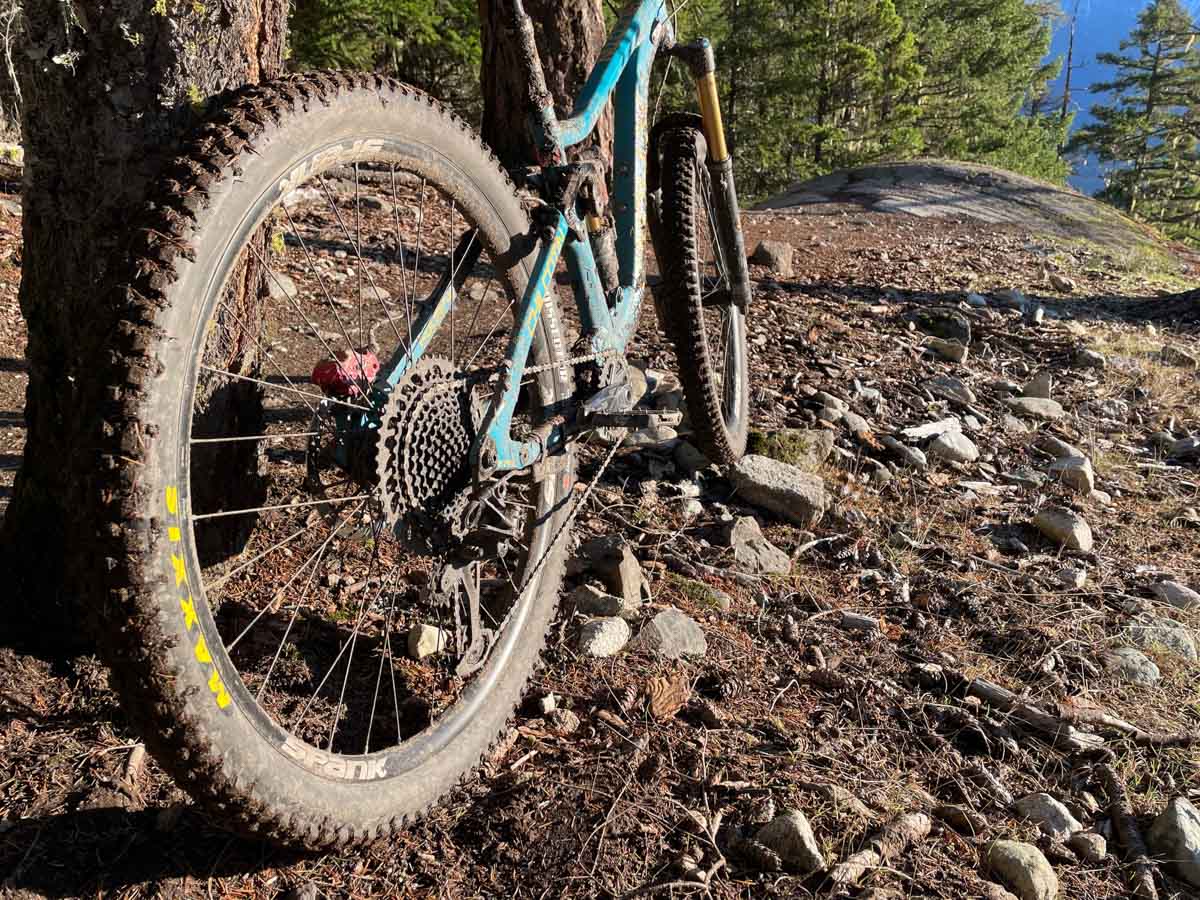
MSRP for the Maxxis Dissector 29×2.4” EXO+/MaxxGrip is $104, while the DoubleDown/MaxxGrip model sells for $116.
Will there be a 32″ Maxxis Dissector soon?
Maxxis seems to be the mainstream tire brand leading the 32″ charge, and it appears this might be the first proper trail bike tire to make the jump to 32″ based on an unlabelled tease at DT Swiss’ Craft Bike Days show. We’ve reached out to Maxxis for comment, and as usall, they are tight lipped stating, “we can’t share anything too detailed about our plans, but there’s a lot in the works for next year.”