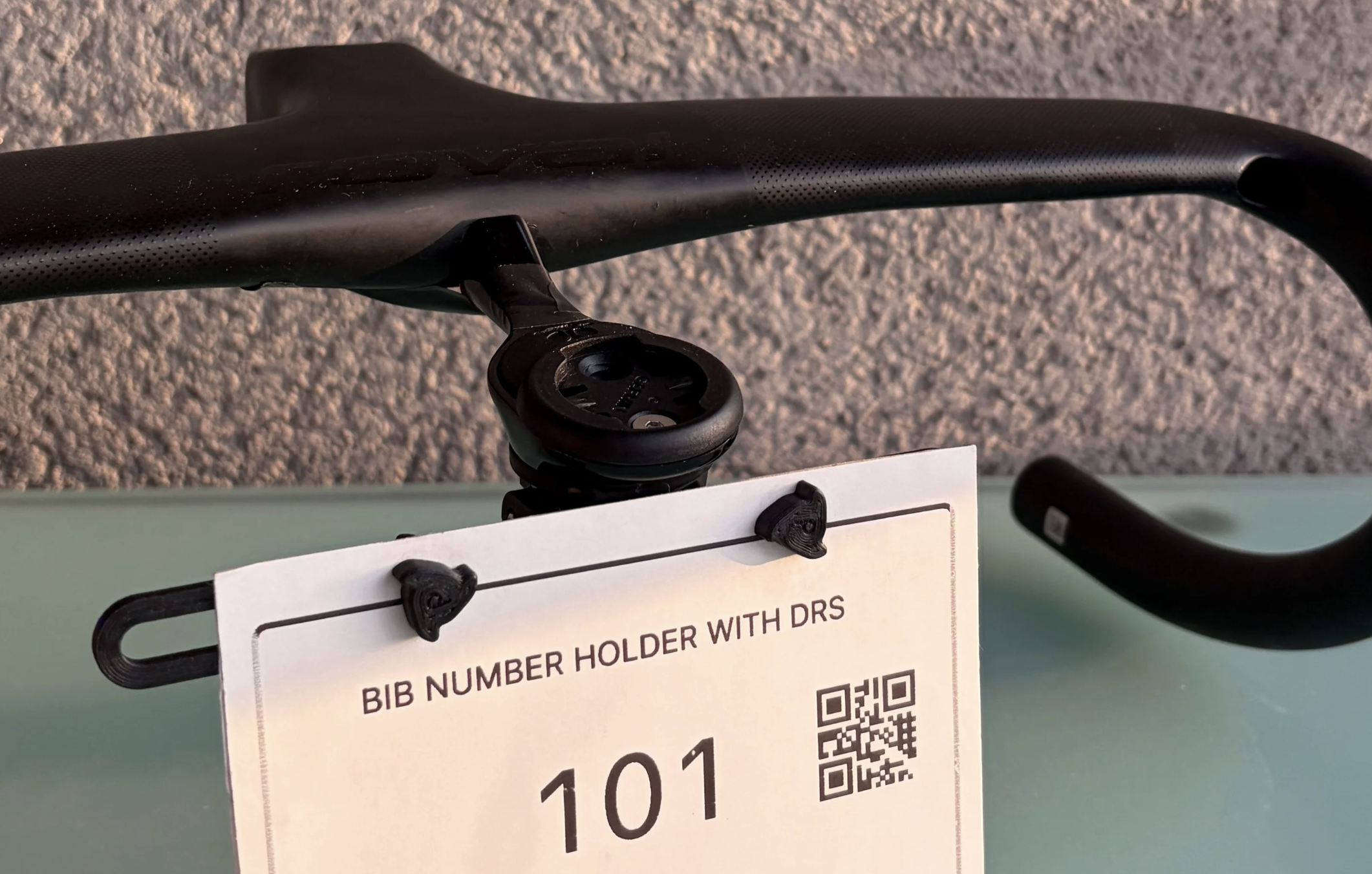


We recently came across an Instagram post from a Spanish component company called Pedra Components. The video showed a number plate mounted on the handlebars, flipping back and forth by 90°, demonstrating that it can lie completely flat. Obviously, this makes the number plate more aerodynamic.
The product is Pedra’s DRS (Drag Reduce System) and, according to the post, is currently a prototype. An electronic noise, similar to that of SRAM mechanical shifting, is heard, leading one to assume someone is hitting a button to activate the system.
And, presumably, this is what is happening. Now, that in and of itself is pretty cool. But what if the DRS number plate could actuate on its own? That is exactly what Pedra is designed it to do.
Pedra is automatically aerodynamic
Now, to be fair, this isn’t the first product like this. I did a quick (and not incredibly extensive) Google search for similar products. I found a Reddit post from a few years ago that showed a somewhat similar product. The post didn’t mention who made the number plate bracket, but there was a link to an IG account. Here, I found a post about the number plate that did mention the company that made it.
They are called So Pro Cycling, and the product is their Out Front Mount. The product looks similar to a GoPro mount. From the photos, it looks like you would manually flip the number plate back and secure it in place, similar to how you would with the action camera.
However, Pedra’s is definitely more high-tech. The following information is from a couple of blog posts the brand shared with me. And, my Spanish isn’t as good as it used to be, so I had some help from the World Wide Web in translating them to English.
Pedra designed the Smart Plate DRS to operate in three different ways. First, a user can manually activate it via a remote on the handlebars. Pedra says this allows you to decide when to “hide” the race plate and when to fold it down, such as at the start/finish line or checkpoints.
Secondly, the Smart Plate DRS can be placed in Speed Mode. Here, a sensor will recognize when the rider exceeds 20 km/h and automatically fold the number plate back into the aero position.
Lastly, the plate can also connect to apps like Strava via Pedra’s GPS Sync mode. In this mode, the number plate will automatically fold back to the aero mode when it matters most. Pedra says this may be, for example, a long flat stretch on a Strava segment where you want to eliminate any and all drag.
How effective is it?
Well, when I asked Pedra this question, they also sent me to another one of their blogs. So, for clarity’s sake, Pedra appears to be conducting their own testing. And again, I had to translate the blog into English, so take all that for what it is worth.
Pedra claims that the little 20 x 15cm number plate generates 7.4 watts of resistance. They say this was the result of an average rider pedaling at 25 km/h.
But where the number plate really hurts you is when you descend. Pedra claimed that descending at 50 km/h generates 60 watts of aerodynamic drag from the number plate. Over a 200km ride/race, they claim that a number plate adds 7-9 minutes.
They also note that they are still in the development phase, so no word on pricing or availability. Also, no word on whether it is or isn’t breaking any rules. As anyone who has ever cut their number plate to make it more aero or zip tied it creatively knows, race organizers don’t like it when you mess with the number plate…


