


Today, at the VeloFollies Trade Show at the Kortrijk Xpo in Belgium, Van Rysel unveiled the FTP^2 (aka FTP²) Concept Bike. But this is more than just a wild, experimental concept bike; the FTP² Project includes an integrated ecosystem — or “panoply” — of bike, shoes/pedals, helmet, and apparel, all developed for maximum aerodynamic efficiency and speed.
Van Rysel states that FTP² “is the most complex project ever carried out by the team, aiming to inspire the general public, as well as the bicycle industry, to continue pushing the boundaries to see what is possible.” While this concept bike and accessories will not be made available to the public, it seems that Van Rysel’s goal is to push the limits of design and integration to inspire future innovation.
Interestingly, with the FTP^2 or FTP² (FTP squared), the team at Van Rysel states that this concept bike is designed to double a rider’s Functional Threshold Power (FTP x 2… so not really FTP²) “and introduce amateurs to the thrill of pro-level speed.” Semantics aside, this bold project combines a Mahle M40-powered aero road bike, a Formula 1-inspired cockpit and electronic controls, a fully integrated, motorized shoe/pedal combo, a clip-on aero helmet shell, and a speed suit.
There’s a lot to unpack here, so let’s check it all out.
Van Rysel FTP² Concept Bike
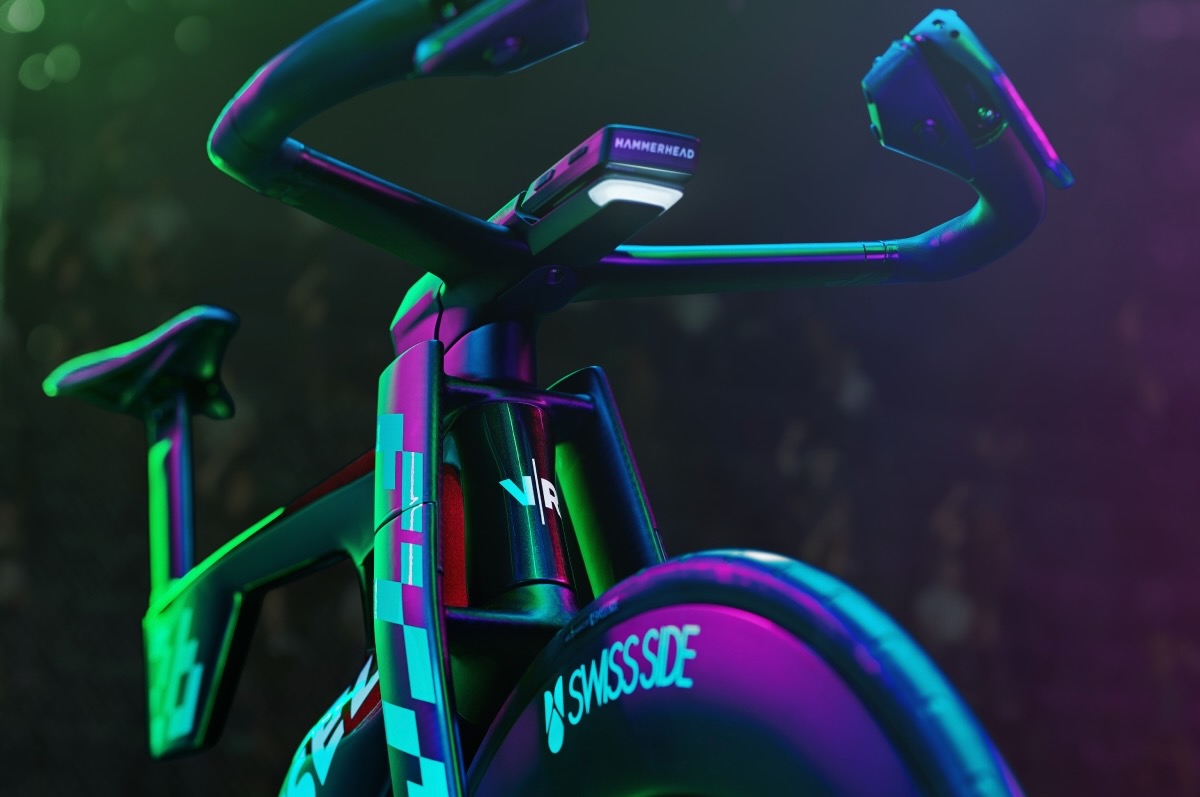
The FTP² Concept bike is unlike anything else we’ve seen and honestly, kinda what you might expect when a bunch of engineers are given total design freedom. Unlike many concept bikes, Van Rysel tells us the FTP² is fully operational and meant to be ridden rather than just displayed at trade shows.
Speed through multiplied power was one of the main goals of this project, and to that end, Van Rysel designed the FTP² to integrate seamlessly with the Mahle M40 pedal assist drive unit. Originally designed for eMTBs, the mid-drive M40 is one of the most powerful units on the market, capable of putting out up to 105Nm of torque and 850 Watts of peak power. Van Rysel says the motor is driven by specific software to optimize and manage it for use on the tarmac so “the athlete transforms into a superhuman engine.” We’re told it has no speed limit and will assist a rider to whatever speed they’re willing to go.
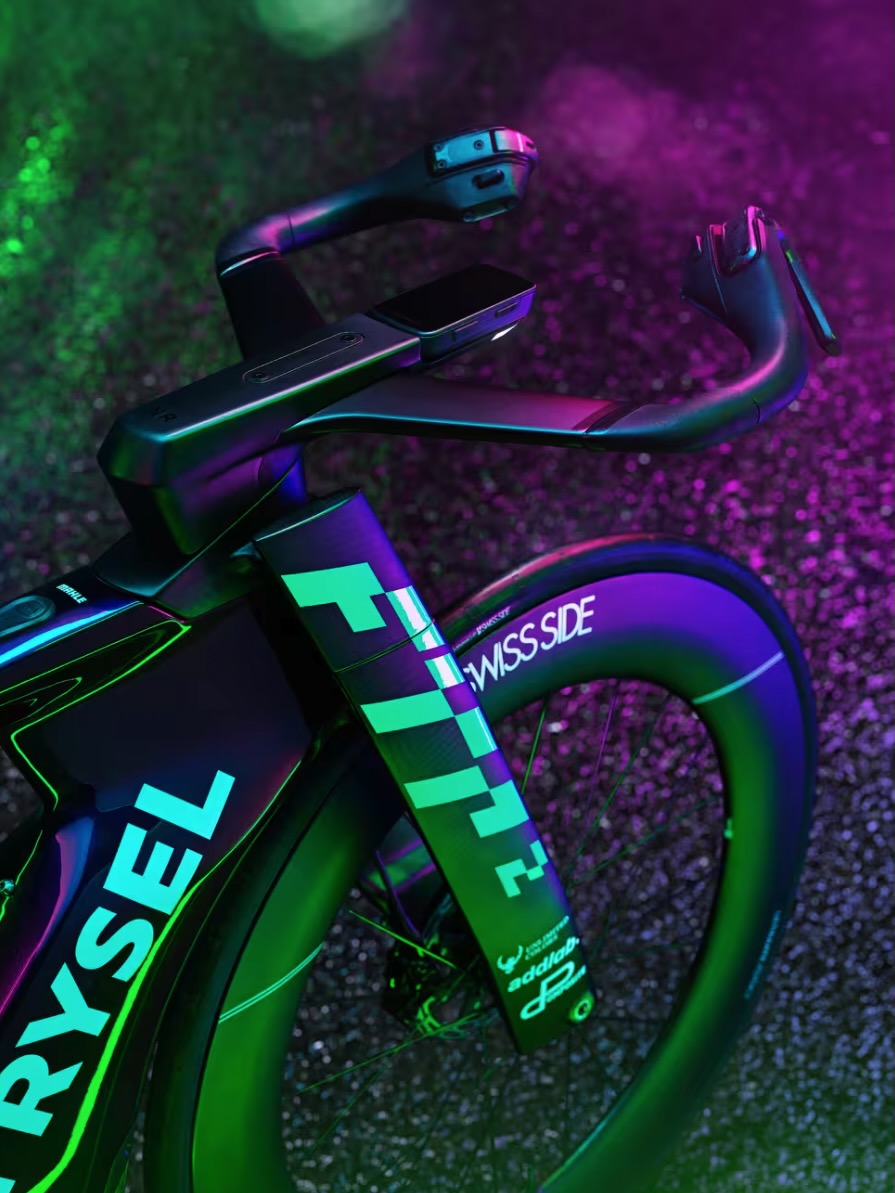
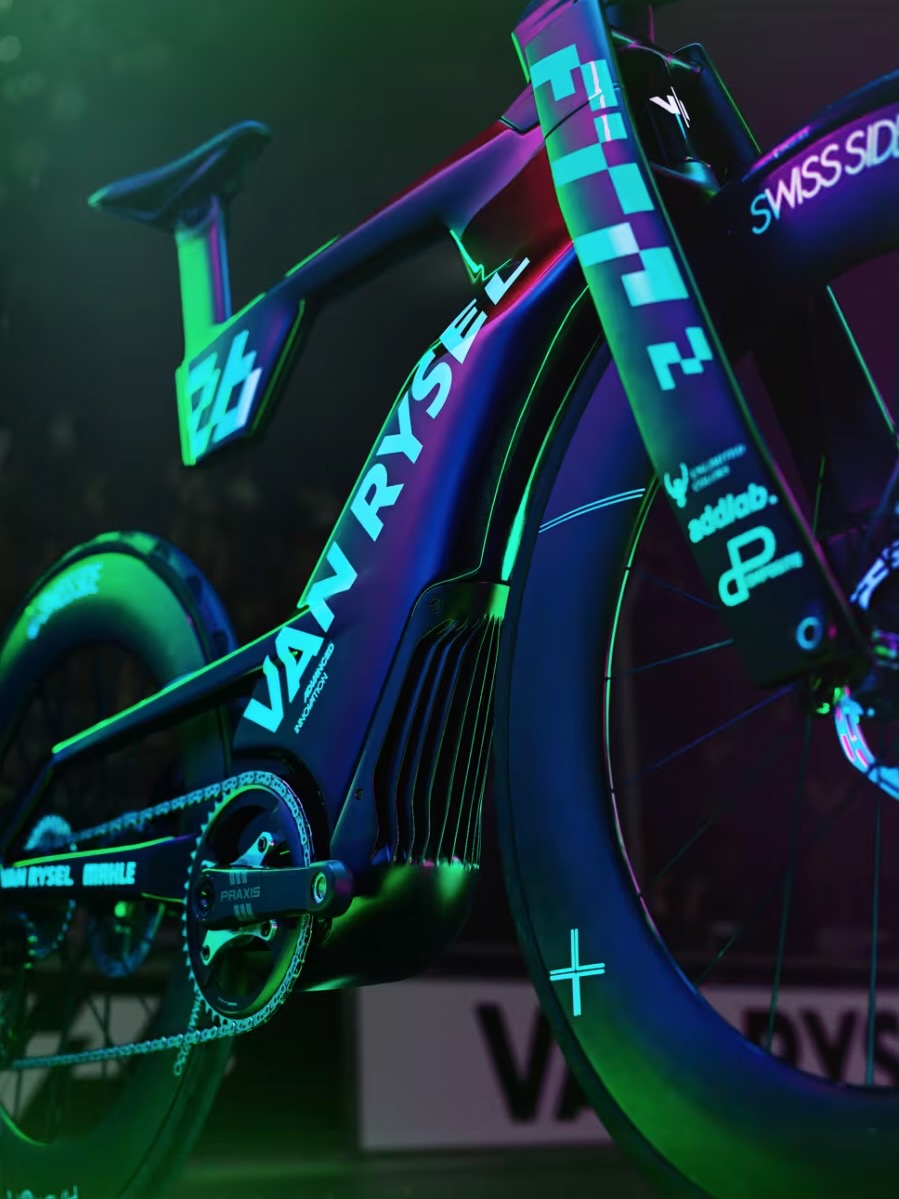
With that power multiplying the rider’s pedaling effort, Van Rysel says that aerodynamics is needed to master such speeds and “becomes the absolute guarantee of safety.” A quick look at the frame makes it abundantly clear the designers went all-in on aero. The two-piece fork with aggressively bladed legs is arguably the most visually striking element, but the entire frame, including the floating top tube beam, is shaped with NACA profiles to smooth airflow. If you are unfamiliar, NACA refers to a set of standardized airfoil shapes initially developed by the National Advisory Committee for Aeronautics (NACA).
Continuing the aerodynamic focus is the F1-inspired cockpit that actually looks somewhat reminiscent of an F1 steering wheel. Van Rysel passed on drop bars and instead designed something a bit more bullhorn-shaped with all of the electronics and brake levers positioned for “flawless ergonomics.” This includes controls for the AXS derailleur, pedal-assist modes, and even “micrometric tightening of the shoes.” You read that right, riders can adjust the tension of the FTP² shoes from the handlebar.
The super-deep Swiss Side Hadron3 850 wheels will undoubtedly also help this bike slice through the air and maximize aerodynamics — as will the aero seatpost and even the integrated computer mount.
FTP² Concept Bike Specs
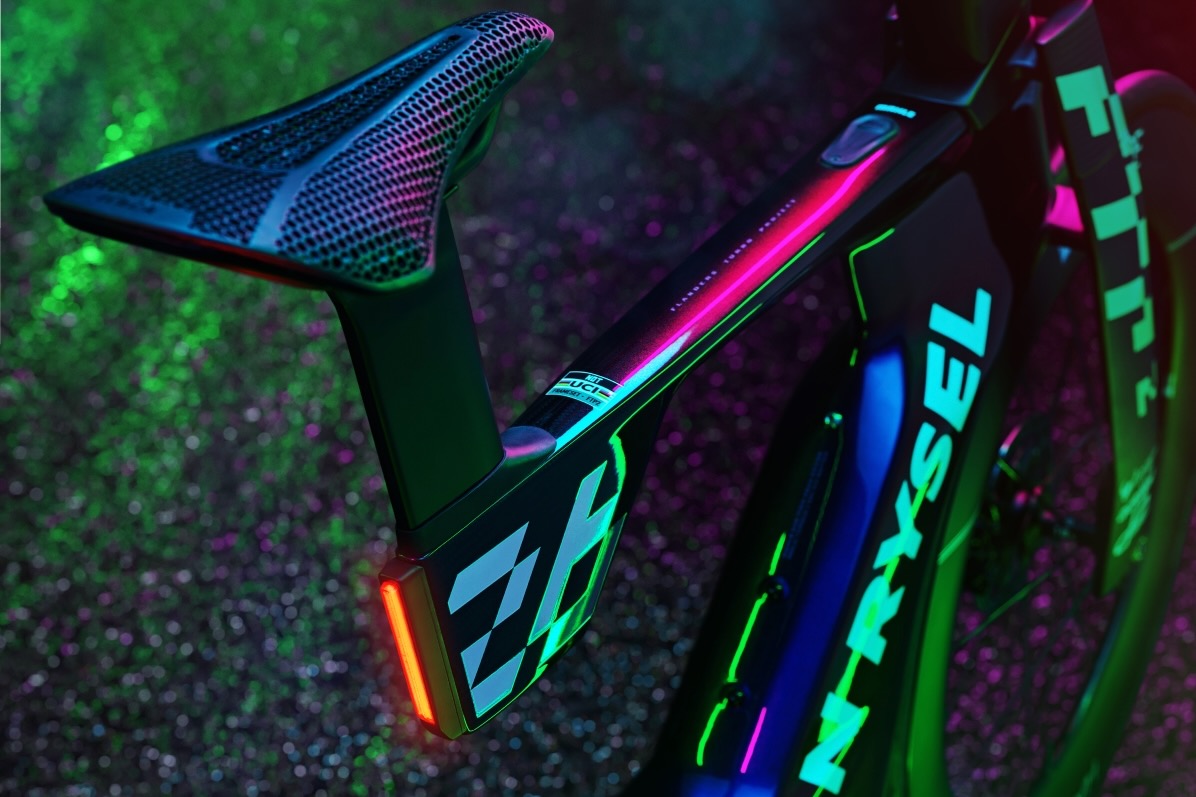
- Frame & Fork: FTP² carbon
- Weight: 15kg (size M)
- Electric Assist: Mahle M40
- Drivetrain: SRAM Red AXS / Praxis carbon cranks
- Wheels: SWISS SIDE Hadron3 850
- Cockpit: FTP² Carbon with integrated AXS / MAHLE / shoe tightening controls
- Saddle: Fizik Argo Vento 00 Adaptive
Van Rysel FTP² Concept Shoe

“No pedal. No laces. Pure speed.” The Concept bike is undoubtedly a unique design and engineering feat, but the FTP² Concept Shoes are just as radical, if not more. According to Van Rysel, the shoe “breaks free from UCI rules to explore new performance potential where the shoe, pedal, and tightening system merge into a single technological block. The goal is simple: eliminate all parasitic interfaces for absolute efficiency.”
The Concept Shoe is really something to look at. Van Rysel essentially combined the shoe and pedal into a single unit, eliminating the shoe-to-pedal interface and the complexities that go with it. At the same time, they introduced a number of other patented technologies and designs, like an axle protruding from the shoe, electronics, and a battery for motorized lacing, and a very aerodynamic NACA shape.
No-Pedal Technology (patent 1)

Van Rysel tells us that the “No-Pedal technology” is the most innovative design feature. According to the brand, “the shoe no longer clips onto a pedal; it becomes the pedal.” The pedal axle/spindle integrates directly into the carbon sole of the shoe, rendering a separate pedal unnecessary. No pedal means no cleat, no hardware, and no shoe-pedal interface. This results in an incredibly low stack, which should help to minimize energy loss and make for very direct power transfer and pedaling efficiency.
Motorized Lacing (patent 2)
If an integrated shoe-and-pedal system wasn’t radical enough, the Concept shoes feature the first motorized tightening system we’re aware of. This system is completely internal and powered by a SRAM AXS battery housed behind the heel. This eliminates all external dials or laces that could impact aerodynamics. Inside the shoe, “a micromotor manages lace tension via an invisible winder,” which is controlled via radio signal from buttons in the cockpit. This means that riders can adjust the tension of their shoes on the fly without letting go of the handlebar.
NACA Aerodynamics (patent 3)
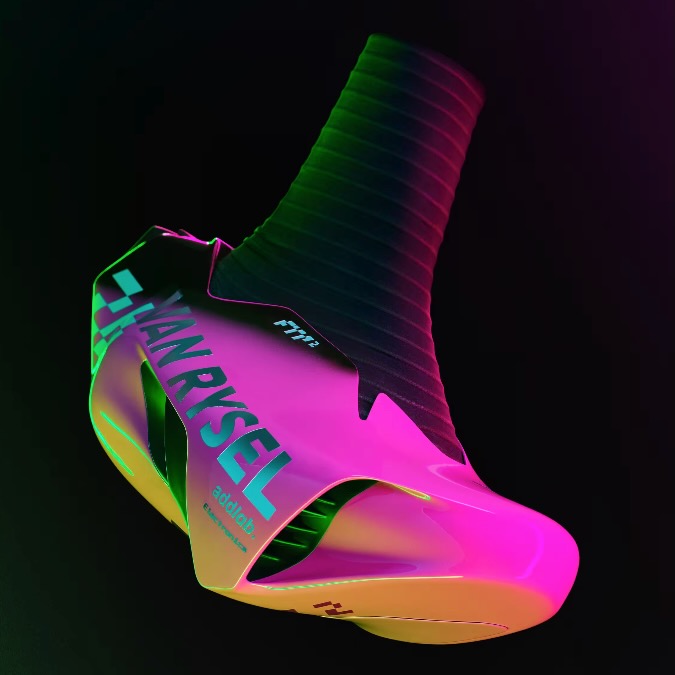
Like the bike, a quick look at the shoe shows that aerodynamics was a top priority in the design. Not only does the motorized lacing system keep the exterior smooth, but the outer shell has a NACA shape that’s meant to mimic an airplane wing profile on its lateral side. According to Van Rysel, this lateral vent with internal fins “captures disturbed air to reduce drag, but also leverages these fins to drive an internal ventilation system.” This system cools both the rider’s foot and the internal lacing motor.
These radical concept shoes with “No-Pedal” technology are obviously an exploration, and Van Rysel says they will inform and influence the design of upcoming high-end shoes. We’re definitely interested in seeing someone get on and off the bike with the Concept Shoes since it isn’t entirely clear how that works!
FTP² Concept Shoe Specs:
- Weight: ~500g (complete system with axle included)
- Outer Shell: 3D printed / lateral NACA shape
- Pedal interface: integrated hub in sole (no-pedal tech)
- Tightening: internal motorization (radio control on bar)
- Upper: integrated aero overshoe / high-speed textile
- Power: removable SRAM battery (heel)
- Sole: internal molded carbon layup
FTP² Aero Helmet
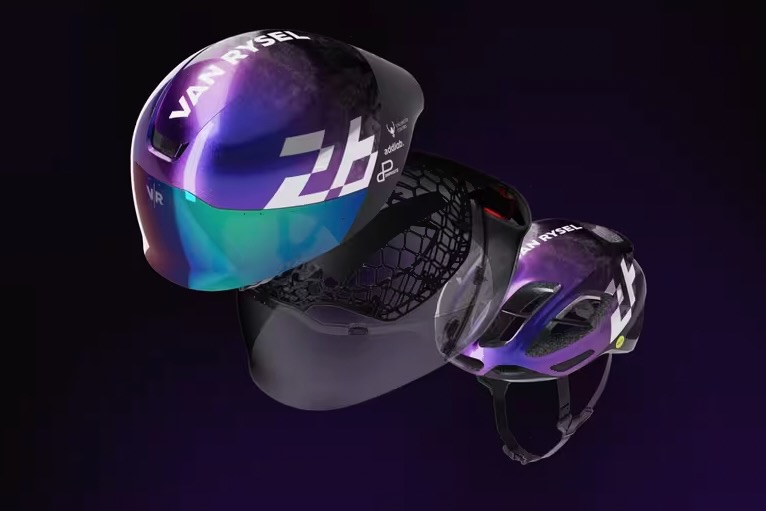
According to Van Rysel, the Aero Helmet is “the fastest shape in the world.” Interestingly, the FTP² helmet isn’t a complete helmet; rather, it is a clip-on cover that transforms an existing helmet into an aerodynamic “weapon of pure speed.” The brand also states that this solution “solves the impossible equation between the lightness of road gear and the aerodynamics of a time-trial profile.”
The X Clip Concept (patented technology)
With the X Clip, Van Rysel has created a modular aero helmet system. Working with Swiss Side — “the global reference in aerodynamics” — Van Rysel sculpted the outer carbon shell with the goal of achieving the lowest drag coefficient. The brand states that it is considered to be one of the fastest shapes on the market, “optimized to reduce drag and stabilize the rider’s head, thereby reducing neck fatigue at high speeds.”
One of the most interesting elements of the design is the modularity. The aero shell clips directly onto the Van Rysel RCR-R road helmet, which serves as the base of the system. According to the brand, “this modularity maintains the safety and comfort of a homologated, ventilated road helmet while providing the air penetration performance of a record-breaking prototype.”

For additional safety, Van Rysel has integrated a rear light into the tail of the aero shell to enhance rider visibility on the road. This light is not an add-on or afterthought; instead, it is part of the design. This means that being seen on the road won’t compromise aerodynamics and should have minimal impact on weight.
Perhaps most importantly, this Concept Aero Helmet points to a not-too-distant future in which a modular system like this may reach production. Rather than owning multiple race helmets, riders could potentially switch between classic and aero setups as needs change.
FTP² Aero Helmet Prototype Specs

- Technology: X Clip Concept (patented system)
- Chassis base: VAN RYSEL RCR-R helmet (homologated)
- Aerodynamic design: Swiss Side collaboration
- Shell material: carbon fiber
- Visibility: integrated LED light signature
- Weight: optimized (carbon/Lattice structure)
FTP² Speed Suit
Rounding out Van Rysel’s FTP² Project ecosystem is the Speed Suit. This is not your typical skinsuit — Van Rysel refers to it as “aerodynamic armor.” With this suit, the brand intends to make it so that riders don’t have to choose between safety and speed.
One of the goals of this suit was to integrate protective elements into the design to demonstrate that padding doesn’t reduce performance or affect aerodynamics. Based on the limited information provided, it isn’t immediately clear where the abrasion-resistant materials or pads are placed, although it’s fair to assume that they’re in locations that may prove beneficial in the event of a crash. More importantly, Van Rysel says the “pads create aerodynamic volumes to sculpt the body and improve airflow.”
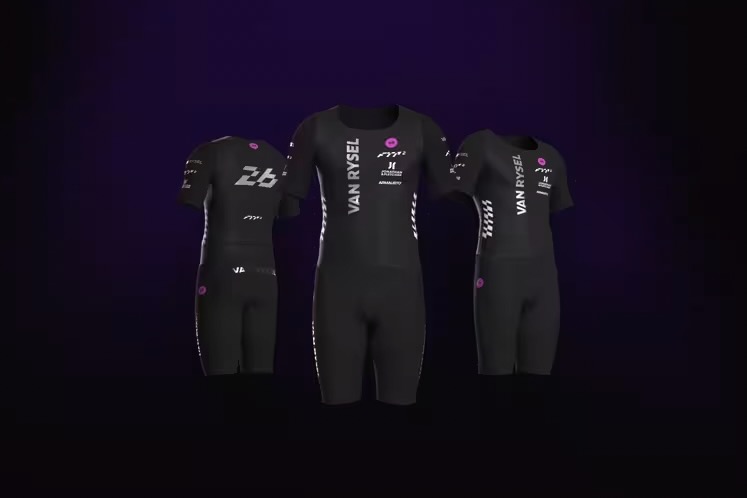
The outer skin, or visible layer, of the Speed Suit is “the exact one currently used by World Tour professionals.” Not only does the textile glide easily through the air, but it covers the internal armor, creating a “perfectly smooth surface against the wind.”
Van Rysel worked with Jonathan & Fletcher engineering for the complex textile architecture. Known for its speed textile engineering, Jonathan & Fletcher workshop contributed its expertise, making it “possible to materialize the ‘Bolero’ cut, a construction that treats the upper body as a single surface to ensure uninterrupted gliding against the wind.”
FTP² Speed Suit Specs
- Architecture: bi-layer system (underwear + suit)
- Textile development: Jonathan & Fletcher partnership
- Inner layer: anti-abrasion base layer with integrated protection pads
- Protection: hyper-flexible pads (dual function: safety & aero)
- Outer layer: pro WorldTour textile
- Design: bolero construction (shoulder/arm optimization)
Van Rysel FTP² Concept Project

Taken on their own and as a complete ecosystem, each of the concept products described above includes bold designs that push the boundaries, and that’s the whole point. With the bike, shoes, helmet, and speed suit, there’s certainly no shortage of out-of-the-box thinking and designs with the Van Rysel FTP² Project. While you can’t buy it and we may never see any of it hit the market, some of these concepts and innovations are sure to influence the design and performance of future products. It’s essentially a rolling laboratory.
“With Project FTP^2, we deliberately stepped outside traditional cycling industry frameworks,” said Wilm Van Hoecke, Project Manager and Van Rysel E-Bike Product Manager. “Doubling the rider’s FTP, removing speed limits, and developing our own electronics, cockpit, and textiles allowed us to explore extreme performance in a controlled and thoughtful way.”
We’re certainly intrigued. We’ll keep you posted if or when we learn more about it. Right now, I think we’re most interested in seeing someone get in and out of those shoes…


